I’m going to concentrate on how photography can encourage us to see the world in several different ways for this week, also going to read the excerpt from “Ways of Seeing, chapter one by John Berger which will help me understand the different perspectives of how we see photography.
Lecture 01: Ways of Seeing
Notes from Lecture One – “Ways of Seeing, and Notes for research:
“Ways of seeing” with John Berger on BBC Four
BOB – is a website that you can watch old archive videos / which allows me to take notes on the programmes they offer.
John Berger – an inspirational art critic, novelist, painter, poet and photographer.
Blue Marble – NASA 1972, Blue Marble 2012
How do we see the world – Notes from Lecture one:
Rene Magritte – “The Key of Dreams” 1930
Rene Descartes – “Dioptrique” 1637
Feller and Van Essen – “Heirachy” Visual 1991
Magnetic resonance imaging (MRI)
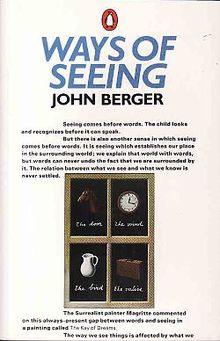
Ways of Seeing is a 1972 television series of 30-minute films created chiefly by writer John Berger and producer Mike Dibb. It was broadcast on BBC Two in January 1972 and adapted into a book of the same name.
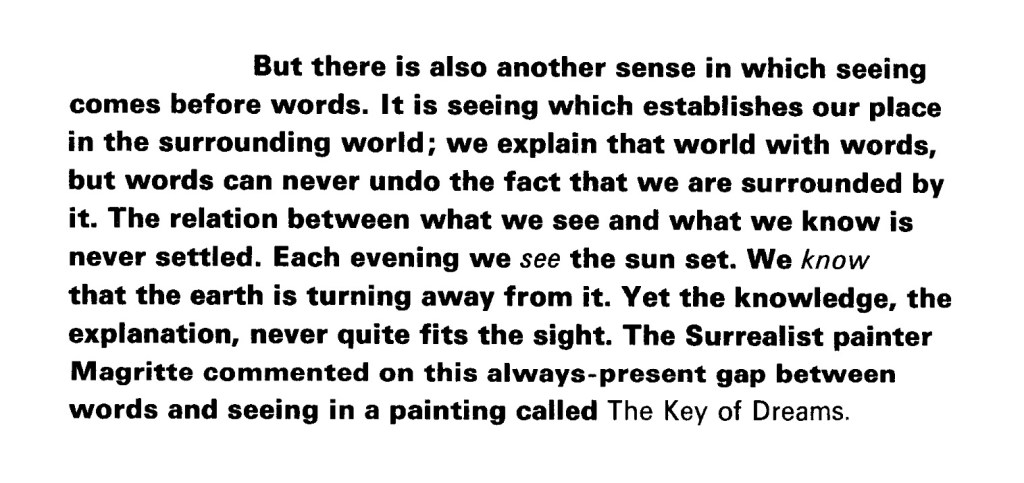
Quotes by John Berger
“We never look at just one thing; we are always looking at the relation between things and ourselves”
“We only see what we look at. To look is an act of choice”
“All creation is in the art of seeing”
“We who draw do so not only to make something observed visible to others, but also to accompany something invisible to its incalculable destination”
How we see the World? (Ways of Seeing)
Everyone sees the world differently, with everyone having different perspectives of seeing, also everyone has a different view on things so for me seeing the world at different stages in my life as when I was a kid I didn’t really take in my surroundings as now I’m a lot older, I’m more observant as the small details from going to the corner shop or walking to work or even for walks in general.
Discussing how we see the world, looking back on the issue, in terms of seeing the world, is that the world we live in now, or opening doors in shops for strangers, or sitting next to someone on the bus and not saying a word until it’s time for you to get off. Because of the modern world we live in coronavirus, the human race has had a huge impact, seeing the world now as a child would be so hard to comprehend, as you were more carefree when you were younger, but you have to be well aware of the various forms of coronavirus because of the current circumstances of the world.
My world view, how I see it won’t be how I saw the world five years ago as I’ve been at the stage of my life now, we’re all fighting for the same dream and that’s to have a future as everybody’s fighting for careers, homes and foods all over the globe as poverty has gotten worse over the years.
If we are literally discussing how we see the planet, we might investigate a variety of places you haven’t been to or even visited across the globe. I’ve only been abroad a few times, and both of them times have been with the school, the trip was to France and Paris. If it weren’t for online images, I wouldn’t have realised what France and Paris should look like as technology has had a huge influence on media and photography. You may not have known about the places we have to give all over the world by seeing photos of people they have taken while on business trips, vacations or weekends away.
Both photographers will offer their own input on this topic in the world of photography as well. For example, anyone who works in a fast-food setting such as McDonalds working random shifts from morning, day, and evening, where photographers can work and explore at any time without a regular schedule, would see the world differently. Photographers have more of a compulsion than a passion as it may be a part-time job to assist you in college, sixth form or even university to work in fast food.
When I capture my photographs, my aim is to try and capture the emotion through the frame of the camera, throughout every photoshoot I set up.
Lecture 02: Stadium / Punctum
The Face of Garbo / Roland Barthes
Garbo still belongs to that moment in cinema when capturing the human face still plunged audiences into the deepest ecstasy, when one literally lost
oneself in a human image as one would in a philtre, when the face
represented a kind of absolute state of the flesh, which could be neither
reached nor renounced. A few years earlier the face of Valentino was
causing suicides; that of Garbo still partakes of the same rule of Courtly
Love, where the flesh gives rise to mystical feelings of perdition.
Mythology is the research and interpretation of the sometimes sacred tales or fables of a society known as myths or the compilation of such stories that deal with different aspects of the human condition: good and bad. Mythology (from the Greek myth for story-of-the-people, and logos for word or voice, so the spoken tale of a people)
Whats does sign mean?
1 : a motion, action, or movement of the hand that means something the teacher made a sign for them to be quiet.
2 : a public notice that advertises something or gives information a stop sign.
3 : something that indicates what is present or is to come the first signs of spring.
Joseph kosuth; one of three chairs 1965:
The work One and Three Chairs can be seen to highlight the relation between language, picture and referent. It problematises relations between object, visual and verbal references (denotations) plus semantic fields of the term chosen for the verbal reference.
Martha Rosler semiotics of the kitchen
Semiotics of the Kitchen is a feminist parody single-channel and performance piece released in 1975 by Martha Rosler. The video, which runs six minutes, is considered a critique of the commodified versions of traditional women’s roles in modern society.
Similar Images / Through Mythology
Everywhere we see them: on billboards, in magazines, on placards for the buses. Glossy images of women and men in silk dresses, pictures of mechanical twin-foil shavers and Dirt Devil hand-held vacuums: they come in the mail and in our Sunday newspapers. And we see them on TV: living rooms with two sofas, sports grounds with white lights, even Wild West gunfights and scenes of bloodstained killings.
Studium
Refers to the variety of available and apparent photographic meanings for someone who objectively interacts with the image. It could be assumed that its meaning was objective. The vast majority of the pictures we come across on a regular basis are made up of them.
Punctum
It relies on personal memories and feelings of the viewers, on memory and the unconscious. This is an experience of subjectivity. It is a “partial object” or information that draws and keeps my gaze in the frame. Words are not easily interacted with.
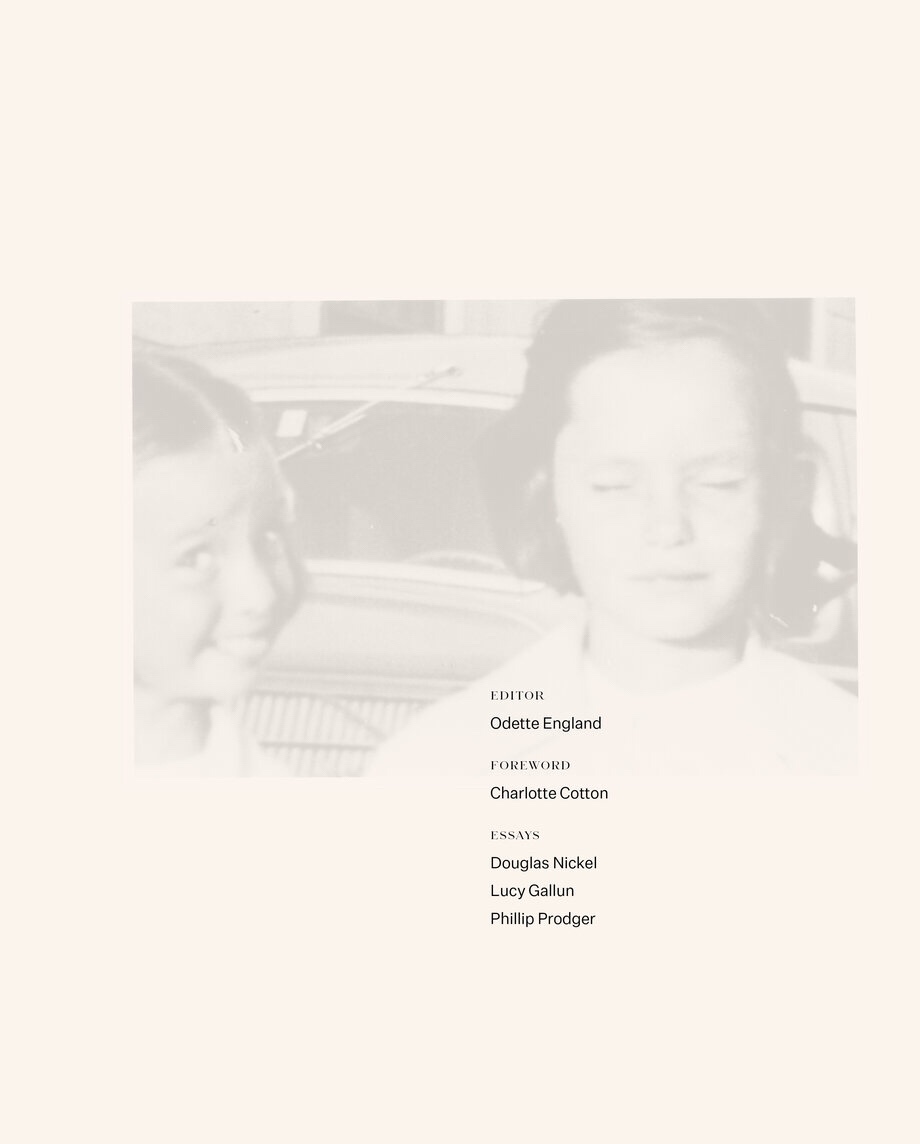
The Winter Garden photograph project marks the 40th anniversary of the book Camera Lucida in 2020. The project is the creation of the artist and writer Odette England.
Odette England invited more than 200 photography-based artists, writers, critics, curators, and historians from around the world to contribute an image and/or text that reflects on Barthes’ unpublished snapshot of his mother.
Keeper of the Hearth is England’s first edited volume. Published by Schilt Publishing, designed by Cara Buzzell. Supported in part by a grant from the Mellon Foundation.
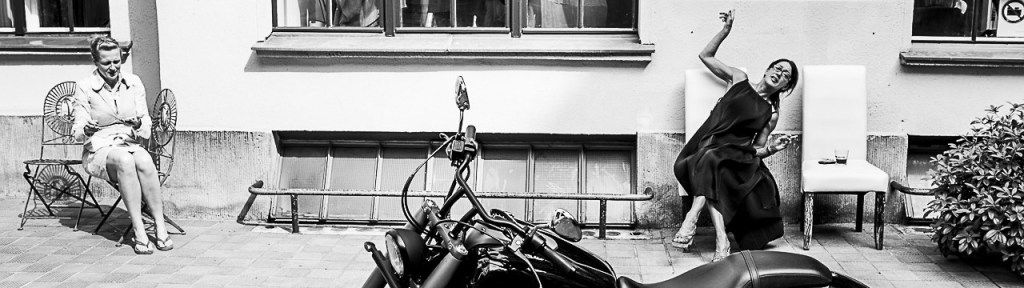
I have chosen this photograph, because there are two sides of the picture, and that got me thinking about the saying of two sides of the story, one of the women is wearing white clothing and the other women wearing black clothing. Also I have picked this photograph because, I think both of the women are trying to find out something as the women in white is looking down and the other one has her hand up but then tilting her body to the right of the canvas.
Once, I’ve looked over the picture a couple of times, the women seem to be holding something in her hands, and it also looks like she’s counting, whereas the other women has a drink has a drink on the chair next to her, also the women in the black clothing has her hand in the air, whereas I think she’s dancing or maybe she’s had too much to drink. Who knows, the image is captured in the moment.
The studio shows the historical, social and cultural representation of the two women sitting outside the building on a hot sunny day as the direction of the light comes from the left side of the image frame.
The punctum punctuates the studio, piercing its viewer as a result. In order to allow the punctum effect, the viewer must refute all knowledge. Barthes insists that the punctum is not simply the sum of the desires projected onto the photograph.
In modern times, the image, such as photography or film, is likely to become a more dominant means of communication than the traditional way of writing. I agree to some extent on this point of view.
Yes, I’m sure that Barthes’ ideas are still relevant in today’s modern image world, because everyone has their own point of view on image, also everyone sees image and they think differently from each other, as it wouldn’t be interesting to see images, if they were all captured in the same way.
Lecture 03: Regarding the Pain of Others
Documenting The World…
Documentary photography commonly refers to a common type of photography used to chronicle historical and historical events as well as daily life events or environments that are both interesting and significant.
The project plans and requirements must be submitted with photos showing the appearance and condition of the property, both on the outside and on the inside, and its location and environment.
Documentary Photography is a documentary tale or storey that involves true incidents to include a credible record or article (and sometimes this is complimented with text). Portraiture, nature documentary, photojournalism, live activities, imagery of the street, self portraiture, photography of sports.
Is Context Everything?
Background is all things. In all correspondence, this forms the context. Without context you can’t interact efficiently. It usually leads to miscommunication when the message is transmitted in one way, but received in another.
Context photography consists of capturing more than incoming light in an image, the context. This suggests, for example, that by creating sounds, for example by whistling, talking or shouting, users can take still photographs that provide a sense of movement or have a certain tint in a frame.
Age of the Image: BBC Four
Art historian James Fox’s documentary series investigates how the influence of photographs has changed the modern world.
Series One: Four Episodes Available
Episode 1 of 4 : A New Reality
James Fox discusses how new ways of viewing the world were created by technical developments in the early 20th century, creating connections between artists, filmmakers, photographers and scientists.
Episode 2 of 4 : Power Games
From Leni Riefenstahl’s propaganda films to the moon landings, James Fox examines how mass communication and modern technologies helped image-makers of the 20th century change culture.
Episode 3 of 4 : Seductive Dreams
James Fox explores how photographs have been used by musicians, film-makers and brands to sell us visions of a happier life.
Episode 4 of 4 : Fake Views
James Fox explores how pictures, from hyper-real paintings to film special effects and deep fakes, have become more powerful and less trustworthy than ever before.
Documentary Life
In collaboration with The Open University, Life is a British nature television series created and produced by the BBC. In order to live, the series takes a global perspective of the specialised tactics and extreme actions that living beings have developed; what Charles Darwin called “the struggle for existence”.
Documentary Photographers:
Eddie Adams (Photojournalism)
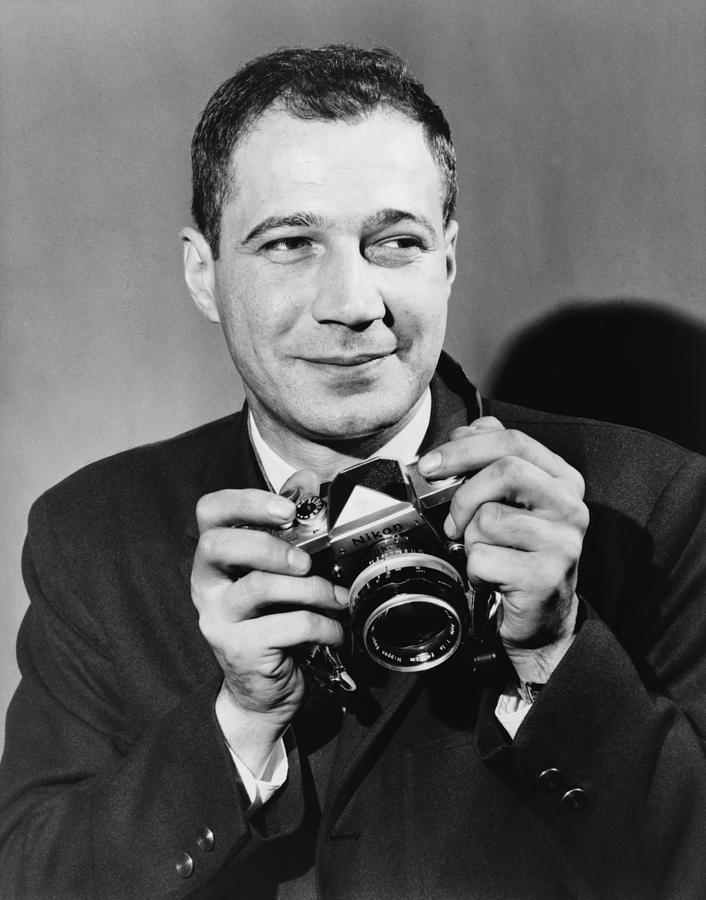
He was an American photographer and photojournalist (June 12, 1933-September 18, 2004), noted for photographs of actors and politicians and for coverage of 13 conflicts. In 1969, he won a Pulitzer Prize.
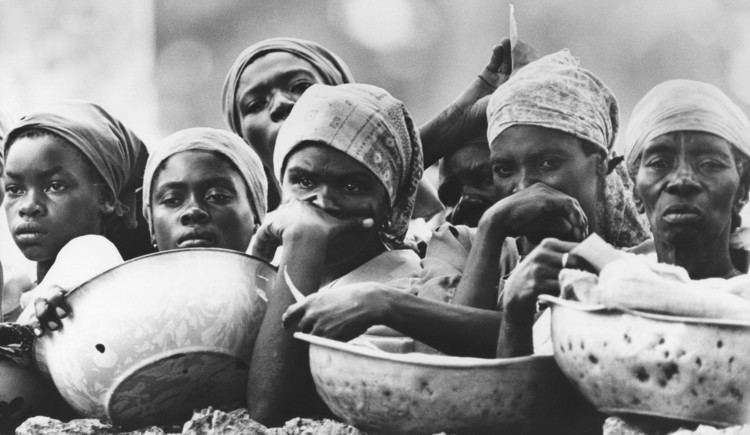
As a combat reporter, Adams entered the United States Marine Corps in 1951 during the Korean War. One of his duties was to photograph the entire Demilitarized Zone shortly after the war, from end to end. This has taken him more than a month to finish.
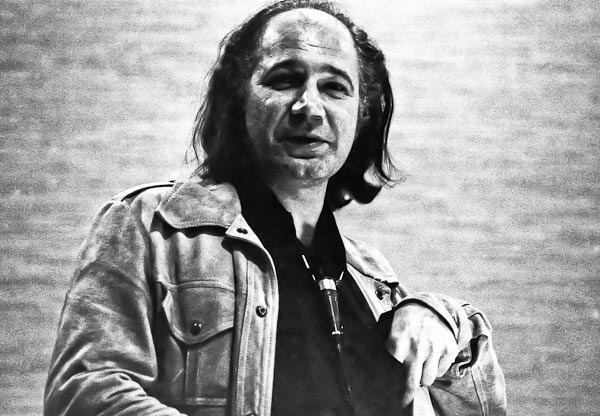
It was while covering the Vietnam War for the Associated Press that, on February 1, 1968, during the opening phases of the Tet Offensive, he took his best-known photograph, the shot of police chief General Nguy’n Ng’c Loan executing a Vietcong inmate, Nguy’n Văn Lém, on a Saigon street.
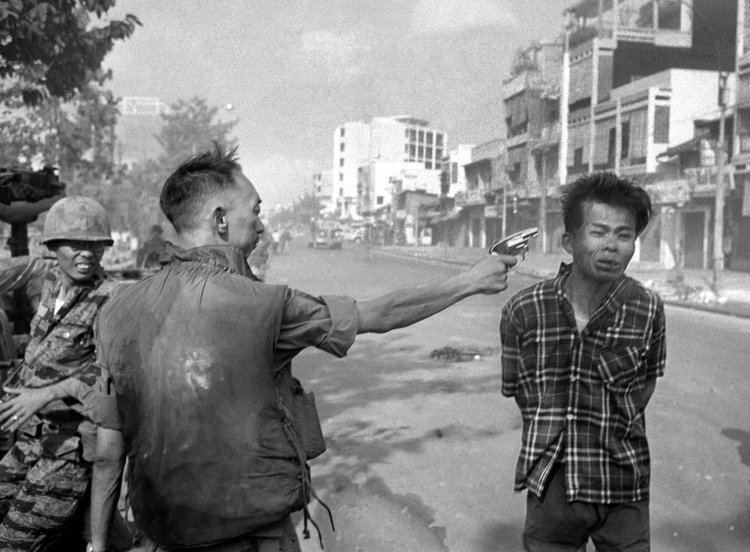
Adams received the Spot News Photography Pulitzer Prize in 1969 and the Photography World Press Photo Award (captioned ‘General Nguyen Ngoc Loan executing a Viet Cong prisoner in Saigon’), but would later regret his popularity. Writer and reviewer David D. Perlmutter points out that ‘no movie film has done as much harm as the 35mm shot of AP photographer Eddie Adams on a street in Saigon. At least one sentence is dedicated (often with an illustration) to the Eddie Adams image when people speak or write about [the Tet Offensive].
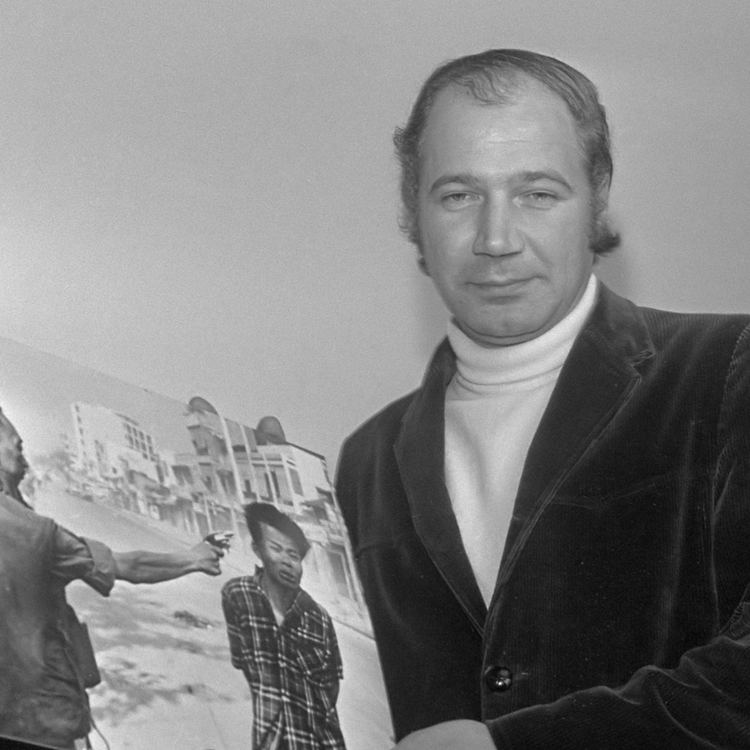
Editors of The New York Times sought an attempt at harmony in anticipation of the effect of Adams’ image. John G. Morris recounts in his memoirs that assistant managing editor Theodore M. Bernstein “determined that the brutality manifested by America’s ally be put into perspective, agreed to run the Adams picture large, but offset with a picture of a child slain by Vietcong, which conveniently came through from AP at about the same time” Nonetheless, although the other much less dramatic picture was ignored and quickly lost, it is Adams’ photograph that is recalled.
Activity for the seminar:
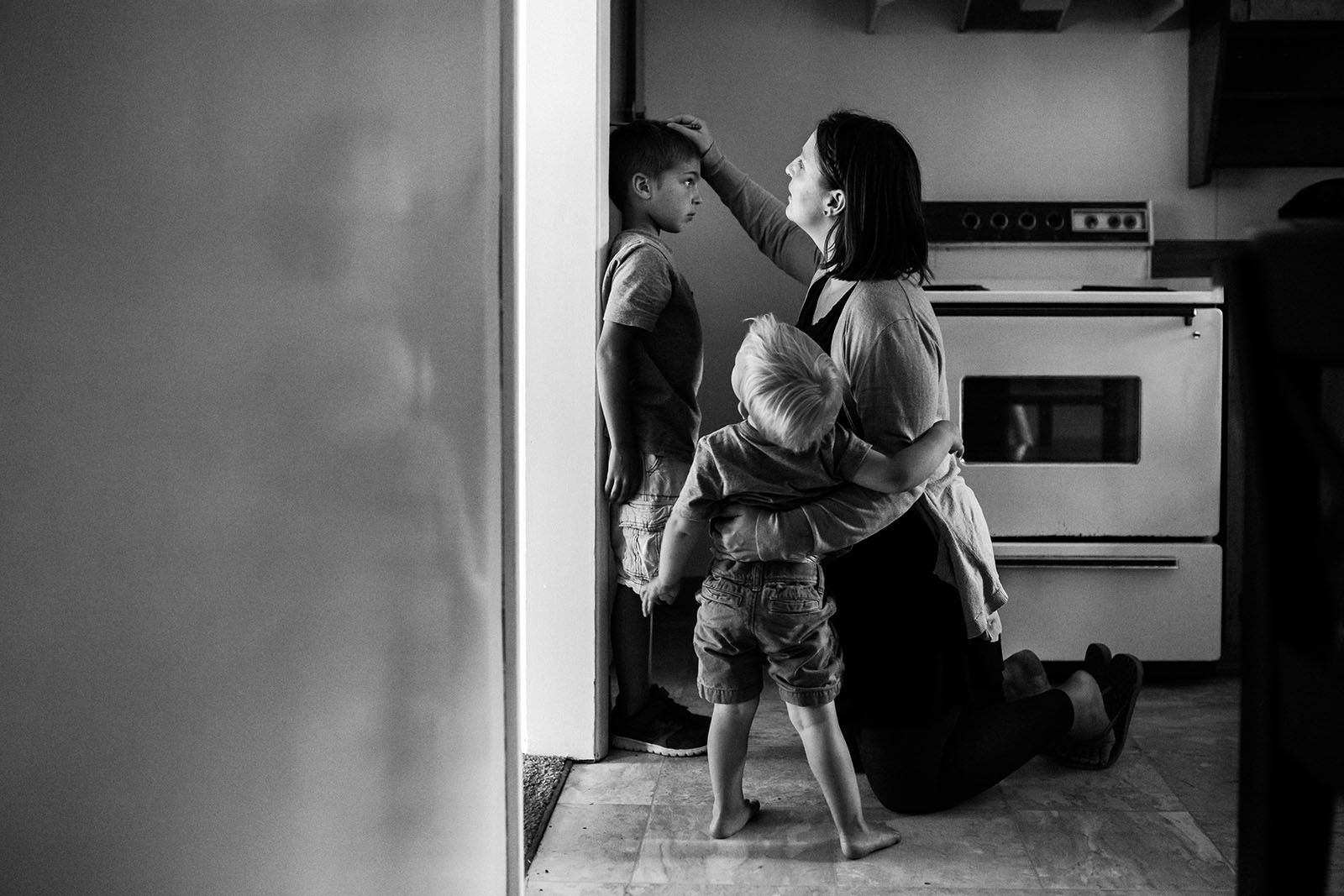
I chose this photograph because it shows the different stages of life as the little boy is documented by having his photograph taken against the door frame or even having his height marked against the door frame with his mother’s pencil, also for me growing up, we’ve always stood next to all the doors of our house to see how tall we’ve grown over the years. I just only make it to walk under the doors as from the age of 16 I’ve been over six foot tall. Yes, referring back to why I have chosen this photograph is that I feel documenting your children’s timelines, as you can always reflect back on when they were a certain age, and that also brings back memories of your children and there childhood.
The photographer is trying to convey the unique moments of her children growing up, the photographer catching the mother getting her oldest son to be counted is really interesting, because growing up is so important, and the younger son staring up at his big brother demonstrates his brotherly affection, because for me the photographer is catching the development of the older son.
The background of the picture is of the mother with her two sons, the photographer caught the mother and her two sons in the kitchen area, the black and white technique brings the extra depth to the image as I would find the black and white image more fascinating to see as a spectator instead of the image being represented in colour.
Yeah, I believe the image offers an accurate picture, when you see what everybody sees, but then everyone reads the image in a different way, so for me, the image is an honest picture for all audiences.
Lecture 04: From Performance to Performativity
Judith Butler argues in “Performative Acts and Gender Constitution: An Article on Phenomenology and Feminist Philosophy,” that gender roles are assigned by the “success” of socially sanctioned activities, from the way we dress to the way we walk all the way to the way we view our social status. Butler insists that one is not born a man or a woman, but rather behaves as one. To put it another way, gender is defined by performance, and gender separation is regulated by performance.
Performativity
Performativity is the capacity of language to cause change in the environment: language may serve as a mode of collective intervention as well as a way of representing the world.
Identity
An individual’s distinctive trait or personality: uniqueness : the psychological identification-based relationship. The state of being similar to something defined or claimed in order to determine the identity of stolen goods.
Normative
Generally, normative means referring to an evaluative quality. In human cultures, normativity is the concept of designating some acts or effects as positive or beneficial or acceptable and others as poor or unacceptable or impermissible. Normative means ‘relating to an appraisal or value decision in most contexts.
Performative
Being or referring to a performative verb, such as vow, that serves to effect a contract or that constitutes the execution of the stated act by means of its utterance — compare constative. Publicly-related or labelled, sometimes artistic success.
Social Media
Social networking is a computer-based technology that, through creating virtual networks and communities, enables the exchange of ideas, thoughts and knowledge. Social networking, by nature, is internet-based and provides consumers with fast electronic information exchange.
Gender Trouble By Judith Butler
According to Butler, it is the tendency of society to separate gender into two distinct male and female hetero-normative divisions that is troubling. It can be said that sex is biologically determined. The majority of individuals are born with anatomically male or female bodies.
Intersect
Transitive verb: by going across or through to pierce or divide: crossing a comet intersecting the orbit of the earth, one line intersects another. A verb intransitive. A point line intersecting at right angles to meet and cross.
Judith Butler
She is a late-twentieth-century American academic whose ideas regarding the performative existence of gender and sex inspired Francocentric philosophy, cultural theory, queer theory, and several schools of intellectual feminism.
Where was she working?
Wesleyan University, George Washington University, Johns Hopkins University, and the University of California, Berkeley, where she was elected Maxine Elliot Professor of Rhetoric and Comparative Literature in 1998, were among the institutions where Judith Butler taught. She worked at the European Graduate School in Saas-Fee, Switzerland, as Hannah Arendt Professor of Philosophy.
What was written by her?
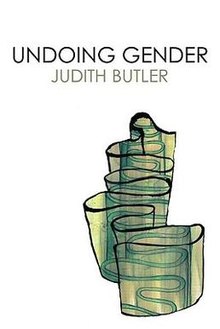
Among other books, Judith Butler wrote Gender Trouble: Feminism and the Subversion of Sexuality (1990), Bodies That Matter: On the Discursive Boundaries of ‘Sex’ (1993), Excitable Speech: A Performative Policy (1996), The Psychic Life of Power: Subjective Ideas (1997), Undoing Gender (2004), and Parting Ways: Jewishness and Zionism’s Criticism (2012).
What is the importance of her?
One of the seminal texts of queer theory was Judith Butler’s Gender Trouble: Feminism and the Subversion of Identity (1990). In the late twentieth and early twenty-first centuries, her performative philosophy of gender and sex, as expressed in that and other books, had a profound effect on the growth of cultural theory, gender studies, and several schools of intellectual feminism.




Images construct our gender and identity?


Sex refers to the biologically constructed features of women, men, girls and boys. This involves the norms, attitudes, and responsibilities that come with being a woman, male, child, or boy, as well as interpersonal relationships. Sex as a social construct ranges from one society to the next and can evolve over time.

Stereotyping has long been embedded in our psyches. We automatically categorise people according to their desires and likings, based on what we have seen or known in practise, no matter how well we understand it or want to stop it.
Activity for the seminar:
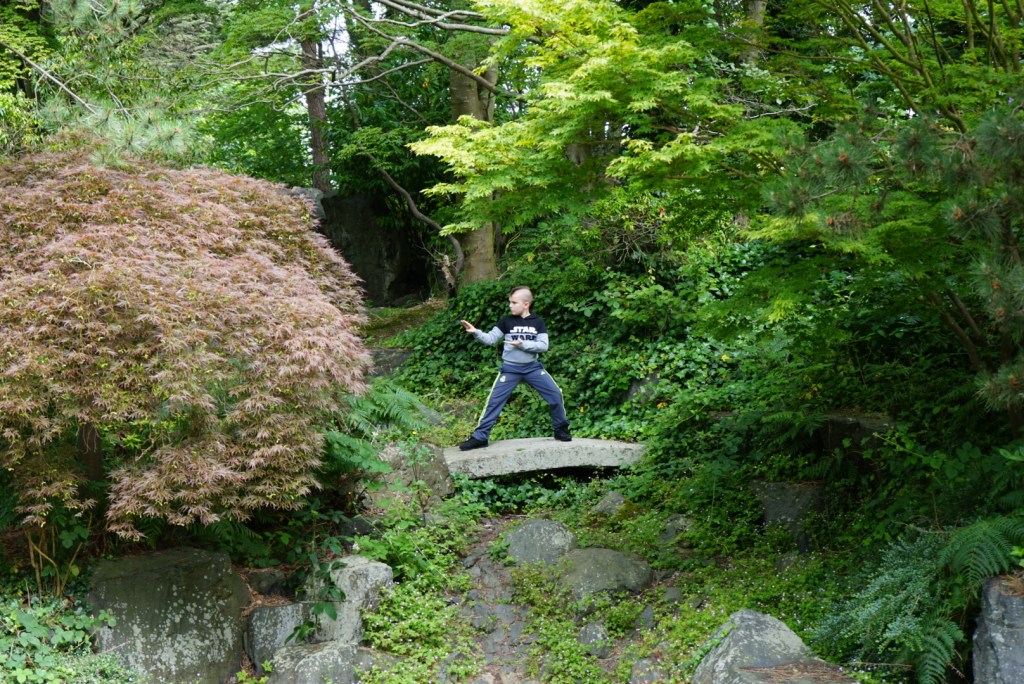
I have chosen this photograph because I was able to get my younger brother to do one of his Shotokan karate stances within the frame of the image; the stance he is performing within the frame of the picture is named “Bassai Day.” What I like about this image is that he is totally focused on what he is doing, which reflects his commitment and love for the sport.
My brother’s position in the picture illustrates what he’s doing when he’s halfway through his kata; his new position is the Kokutsu Dachi, which he had to step into kokutsu dacha with right leg and block shut uke
The personality of the picture is determined by his attire, which he is wearing because he loves football and sci-fi merchandise. This represents his love of athletics as well as science fiction. Since he must use his hands constantly in his Sotokan stances, my brother’s hand gestures are used to recognise the performative acts in the picture.
Lecture 05: Orientalism and the Other
What is the concept of Orientalism?
“Orientalism” is a way of looking at the world that imagines, highlights, exaggerates, and distorts divisions between Arab peoples and civilizations and Europe and the United States. It often entails seeing Arab culture as alien, primitive, uncivilised, and even violent.
What does Orientalist mean?
Someone from the West who explores the literature, culture, history, or traditions of countries in eastern Asia is known as an Orientalist.
What is an example of Orientalism?
Information or customs unique to Asian history, people, or language are referred to as orientalism. Japantown in San Francisco is an example of Orientalism. A quality, tradition, or mannerism that is unique to or characteristic of the Orient. Western artists’ use of decorative components that evoke Asian or North African cultures.
Summary from Edward Said (1979) Orientalism
‘The Orient was almost a European invention, and had been since antiquity a place of romance, exotic beings, haunting memories and landscapes, remarkable experiences.
Unlike the Americans, the French and the British – less so the Germans, Russians, Spanish, Portuguese, Italians, and Swiss – have had a long tradition of what I shall be calling Orientalism. A way of coming to terms with the Orient that is based on the Orient’s special place in European Western experience. The Orient is not only adjacent to Europe; it is also the place of Europe’s greatest and richest and oldest colonies, the source of its civilizations and languages, its cultural contestant, and one of its deepest and most recurring images of the Other. In addition, the Orient has helped to define Europe (or the West) as its contrasting image, idea, personality, experience. Yet none of this Orient is merely imaginative. The Orient is an integral part of European material civilization and culture. Orientalism expresses and represents that part culturally and even ideologically as a mode of discourse with supporting institutions, vocabulary, scholarship, imagery, doctrines, even colonial bureaucracies and colonial styles.’
Edward Said
He was a public intellectual, a professor of literature at Columbia University, and the father of the scholarly field of postcolonial studies. He was a resident of the United States by his father, a U.S. Army veteran, and was born in Mandatory Palestine.
What are Said’s three definitions of Orientalism?
The reader can see that by Orientalism, I mean a variety of topics, all of which are, in my view, interdependent. Academic Orientalism is the most widely known name for the phenomenon, and it is also used in a number of academic institutions. Anyone who lectures, writes about, or researches the Orient in its particular or general forms, whether as an anthropologist, sociologist, historian, or philologist, is an Orientalist, and what he or she says or does is Orientalism.
A more general context for Orientalism is related to this scholarly tradition, whose fortunes, transmigrations, specialisations, and transmissions are in part the focus of this research. Orientalism is a philosophical school of thought that makes an ontological and epistemological distinction between “the Orient” and (most of the time) “the occident.” As a result, a vast number of writers, including poets, novelists, historians, political theorists, economists, and imperial administrators, have adopted the fundamental distinction between East and West as the starting point for elaborate accounts of the Orient, its inhabitants, traditions, “spirit,” fate, and so on. Orientalism as I research it here is primarily concerned with the internal continuity of Orientalism and its ideas about the Orient, despite or without any correspondence, or lack thereof, with a “absolute” Orient.
“The exchange between scholarly and more or less inventive interpretations of Orientalism is continuous, and there has been a significant – perhaps even supervised – traffic between the two since the late eighteenth century. I’ve arrived at the third definition of orientalism. Orientalism can be debated and studied as a corporate entity for engaging with the Orient — dealing with it by making claims about it, approving views of it, explaining it, educating it, resolving it, and ruling over it: in short, Orientalism as a Western style for dominating, reforming, and ruling over the Orient.
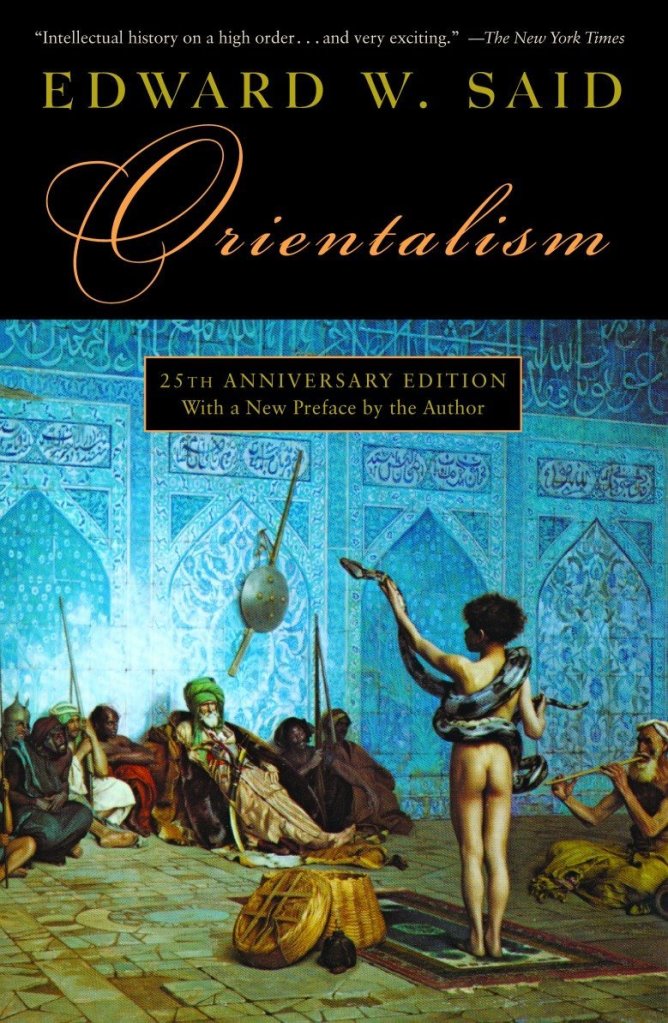
Orientalism is a 1978 book by Edward W. Said, in which the author establishes the eponymous term “Orientalism” as a critical concept to describe the West’s common, contemptuous depiction and portrayal of “The East,” i.e. the Orient.
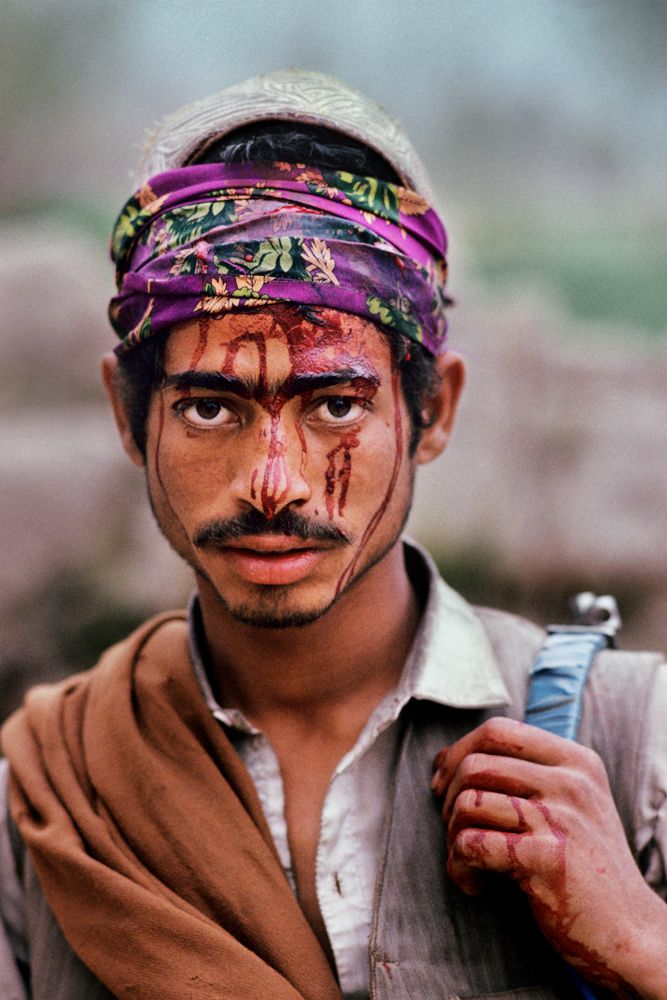
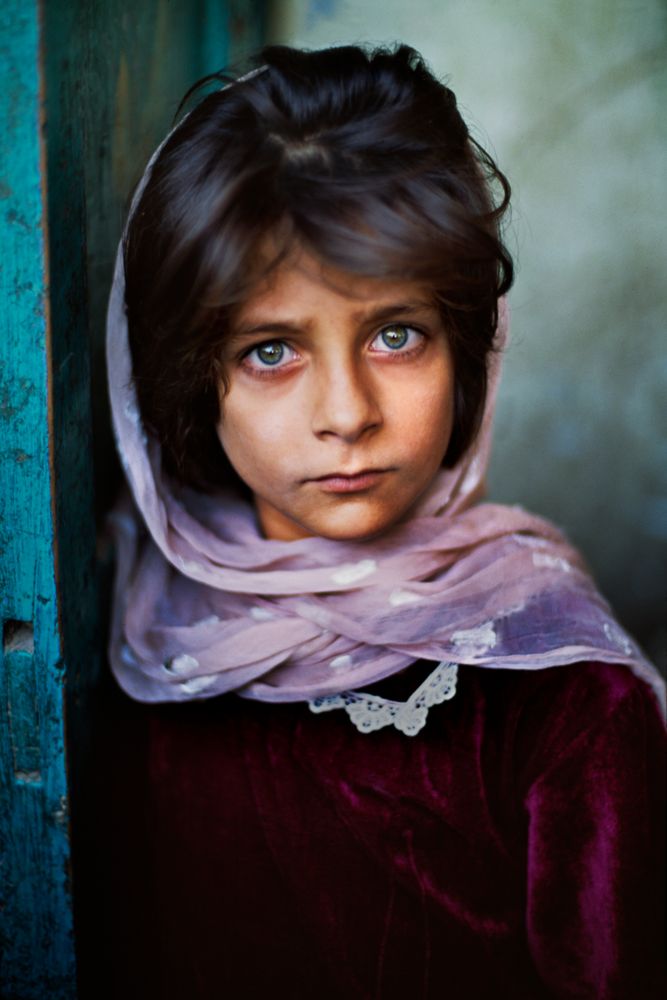
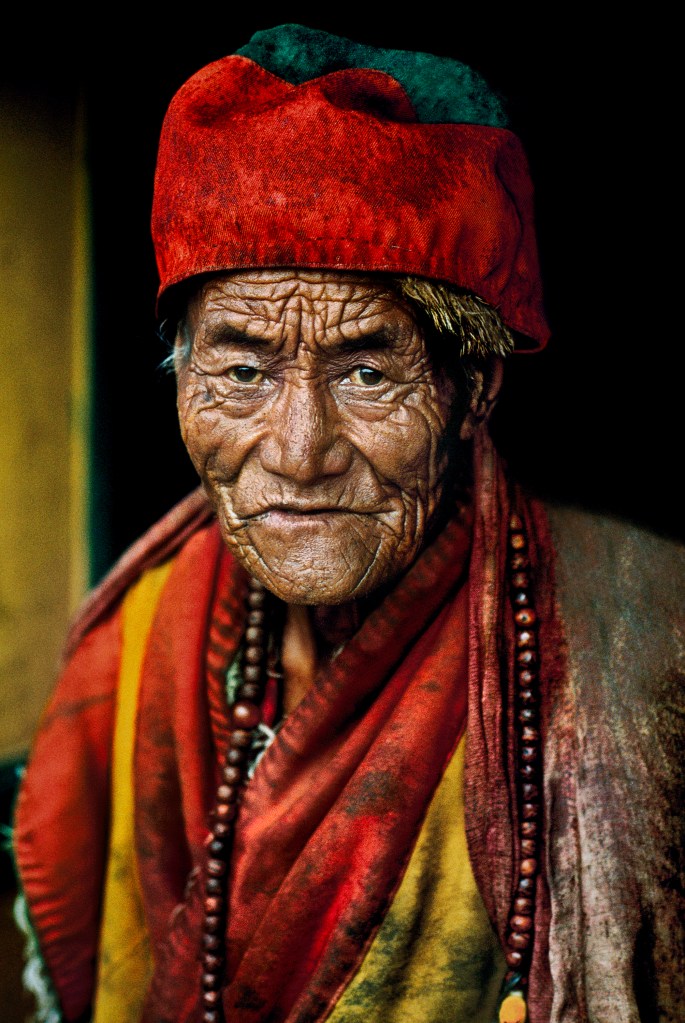
Steve McCurry
He is a filmmaker, freelancer, and photojournalist from the United States. Afghan Child, a photograph of a young woman with piercing green eyes, has been featured on the cover of National Geographic on many occasions. McCurry has worked with National Geographic on many assignments and has been a member of Magnum Photos since 1986.
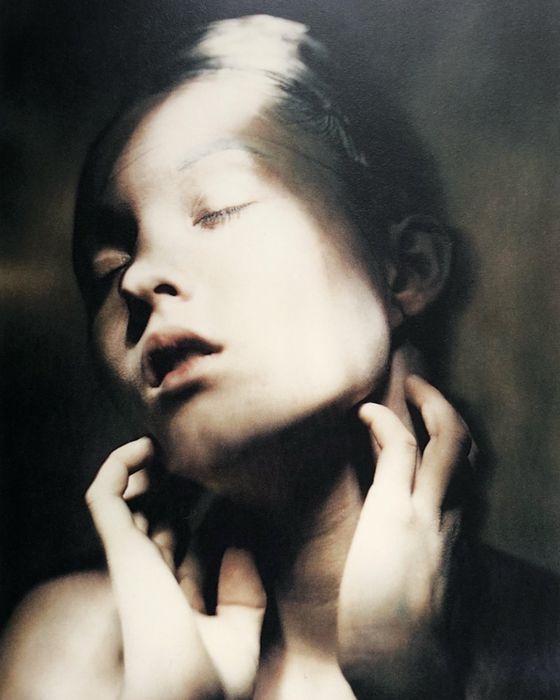
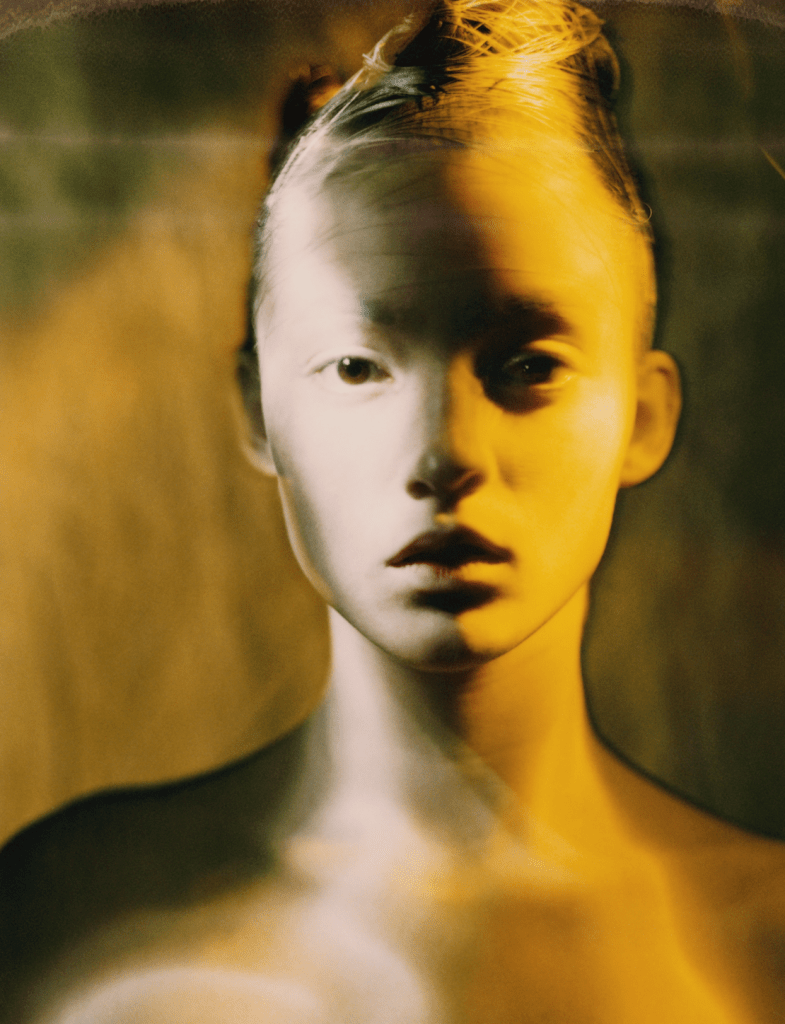
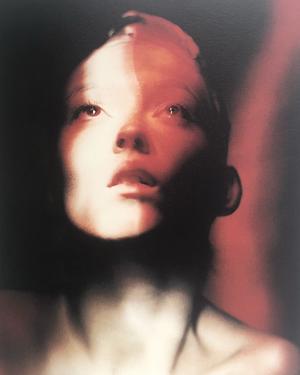
Paolo Roversi
He has lived and worked in Paris for over 35 years. In 1974 he became the assistant to British photographer Lawrence Sackmann whom he credits with teaching him “everything (he) needed to know in order to become a professional photographer”.
Jacques Lacan
In the early 1920s, he began practising medicine, specialising in psychiatry and interning at Paris’s Sainte-Anne Hospital. He was invited to attend the Paris Psychoanalytic Society in 1934, soon after defending his well-received work On Paranoid Psychosis in Relation to Personality. Around this time, he also began psychoanalysis.
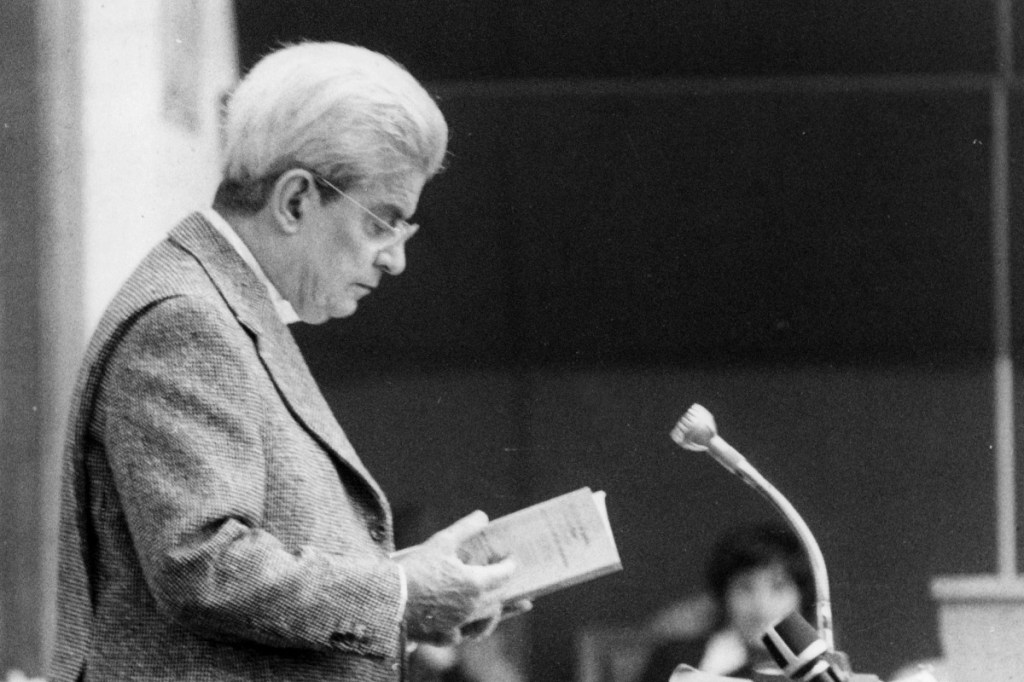
Activity for the seminar:
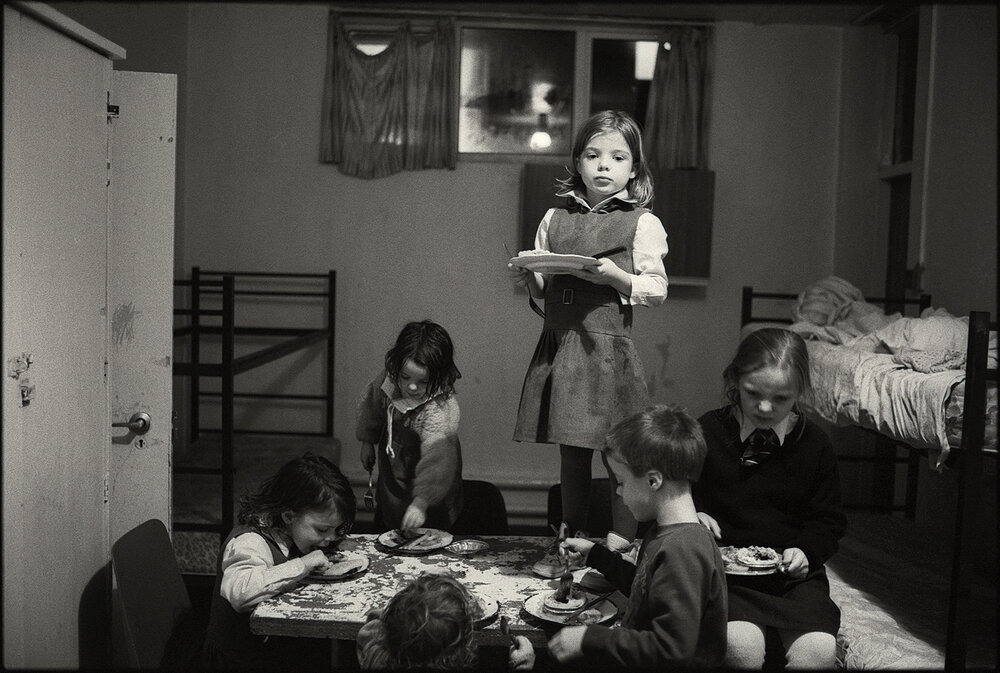
This illustration was selected because it accurately depicts how all of the children behave at dinner. Just a couple of the children are eating what they’ve all been offered, indicating that not all of the children are unhappy with what they’ve been given for dinner. As compared to the older three children’s facial expressions, one seems to be fed up, putting her plate up as if to say, “I’ve had enough of what I’ve been getting at dinner.” Also, the two bunk beds on the sides of the image are visible, but there are only three mattresses, which leads me to believe that all six children share the beds inside the image.
Lecture 06: The Work of Art of Mechanical Reproduction
Photography allowed for the technical replication of art. Art could be anything, and art could be found everywhere. This shifted our reality by collapsing time and space and altering our vision.
The digital revolution, like the Renaissance, has impacted every part of our lives. Image creation is gradually resembling our physical reality. On our screens and in our hearts, we take this truth with us.
These artificial realms are becoming more real to us. To stay in business, digital media depends on people uploading and creating content. These realms have been familiar and embedded in our lives.
The School of Athens (c1500) Raphael
The Renaissance era covered a period around the 15th and 16th centuries, it was seen as a time of revolution in culture that spread across Europe and marked the transition from the Middle Ages to modernity. It affected all aspects of society, from science and technology, to music and philosophy, but notably the arts, especially painting, and also widespread use of the printing press. For painting it marked the ability of painters to make realistic representations, and for writing it was the first time manuscripts could be printed and distributed to anyone who could read. This facilitated the wide circulation of information and ideas, and had a huge impact throughout Western societies influencing much of our culture to this day.
Renaissance
The Renaissance (French: “Rebirth”) was an era of European civilization that emerged shortly after the Middle Ages and is historically considered to have been marked by a rise in interest in Classical scholarship and values.
The Renaissance also saw the discovery and conquest of new lands, the replacement of the Ptolemaic method of astronomy with the Copernican system, the fall of feudalism and the rise of trade, and the invention or application of potentially important inventions like paper, photography, the mariner’s compass, and gunpowder.
However, it was largely a time of renaissance of Classical learning and insight for intellectuals and thinkers of the day, after a long period of intellectual decay and stagnation.
Trompe l’oeil
The English version is ‘eye trick.’ This painting (like all paintings) deceives the eye into believing it is 3D when it is only 2D. It gives one the feeling of being in the real world. This history of Western art and its relationship to photography was explored by John Berger. In this scenario, it’s the camera’s emulation of a Renaissance painterly perspective.
The Matrix (1999)
The Matrix is a science fiction film that was released in (1999). In a simulated universe, the film explores an alternate reality. The film’s release coincided with the start of the digital revolution. That was the same year that the Dot Com financial bubble exploded, there was widespread anxiety over the Millennium Bug, and we began to see modern emerging realities for the first time. Things began to occur that seemed to be real but were not, especially in photographs.
The digital transition of the last 20 years has arguably been the most significant cultural change since the Renaissance, affecting every part of our lives. The internet, like the printing press, allows photographs and facts to be easily reproduced everywhere in the world. It’s altered the way we live, work, socialise, and ingest visual culture. But also how we see ourselves in contrast to the rest of the universe, and therefore our view of reality.
Where it comes to pictures, one important change in recent decades has been how images have become more like reality while still becoming more like reality. And, like the people in the cave staring at the shadows, it’s getting more impossible to differentiate between them. Can we trust what we see if the world around us is turning into an image?
Mimesis is the technological imitation of how objects appear in the real world. To put it another way, the right to clone.
Photoshop
Photoshop’s creators, John and Thomas Knoll. The power to edit pictures in a significant way. This technology is now commonplace and commonly used in the mainstream. The use of filters and camera phone technologies is an extension of this. The power to edit realities and post them to web channels in real time.
John Knoll also worked for Industrial Light & Magic, the studio behind Monsters, Inc.
Monsters Inc
All seems to be what you would expect from either your childhood memory or the myth of movie-making at first glance. Since we are familiar with the language of animation, this animated sequence seems to be quite familiar. The clip has a “recognition scene,” which is a tense sequence that shows the film’s underlying plot. What we thought was true turned out to be a computer simulation run by Monsters Inc, a strong corporation.
Digital Culture
A digital culture is a term that explains how technology and the internet are affecting our human experiences. It’s how we act, think, and interact as members of society.
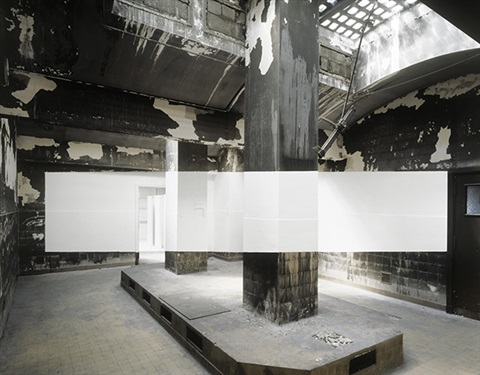
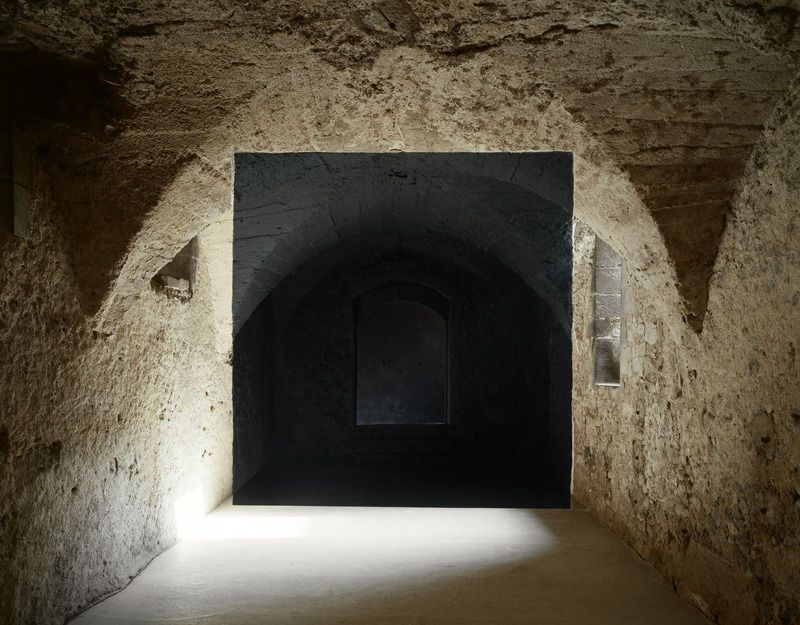
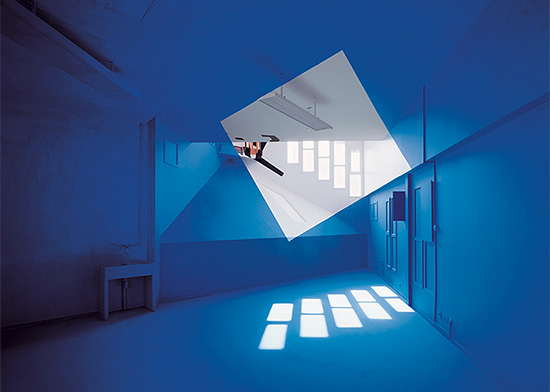
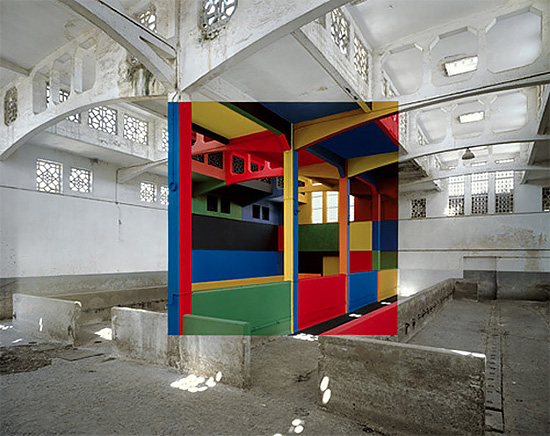
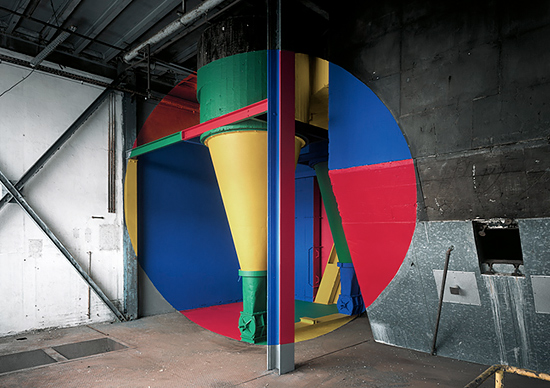
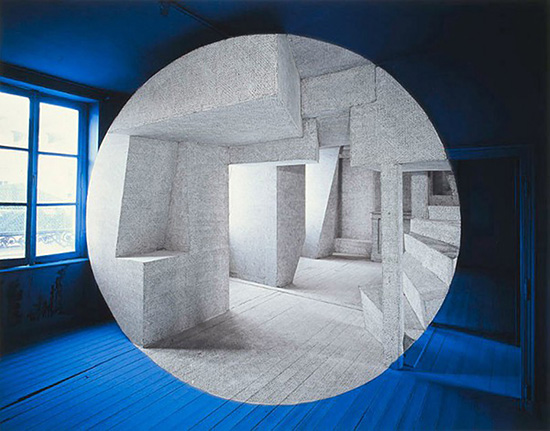
Georges Rousse
Georges Rousse is unmistakably a photographer: settling on the composition, cropping and framing, and clicking the shutter are all integral parts of his method. But he is also a painter, sculptor, and architect, working with his worksites in the same way as a painter works with his canvas or a sculptor works with clay or marble.
His thesis deals with our connection to Space and Time, which is at the core of his questioning of the concept of art.
His images deal with mankind’s troubling connection to time in industrialised culture, as well as the marks he leaves on the environment, thus evoking the image of a place and its poetic metamorphosis. The places chosen for his installations are symbols for Time as it hurtles toward death: forgotten, ignored, in ruins, or scheduled for disaster.
Abandoned Buildings
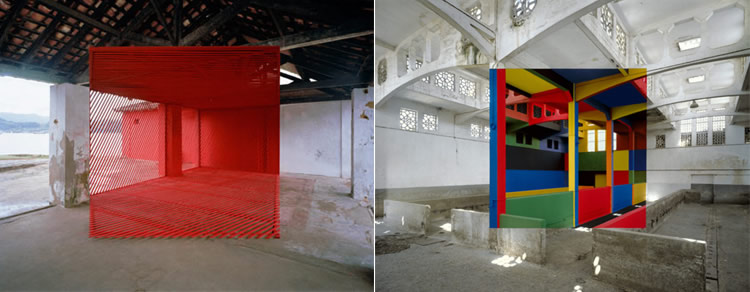
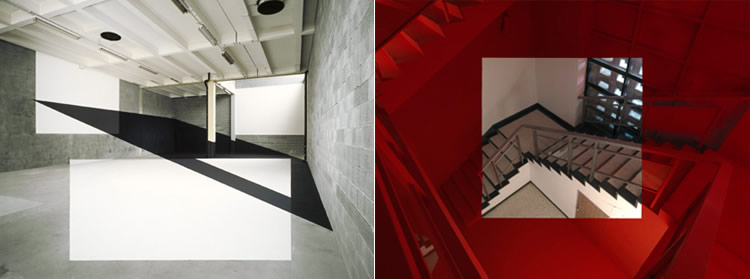
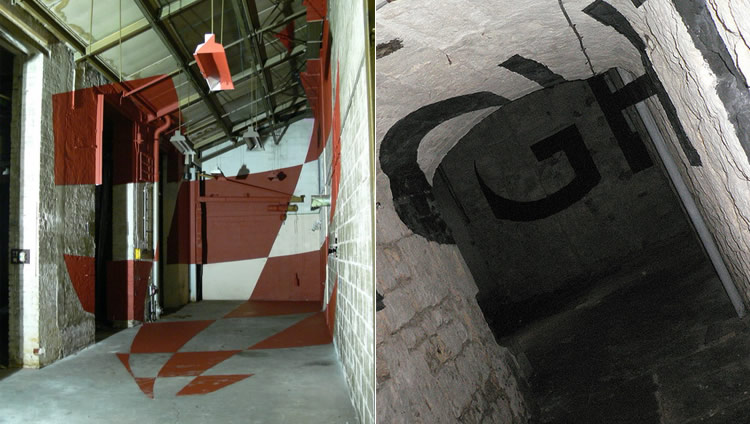
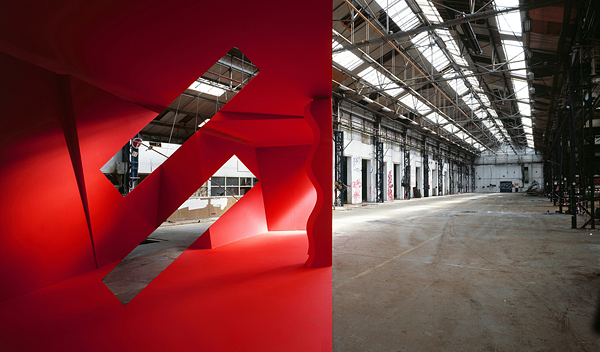
Marseille
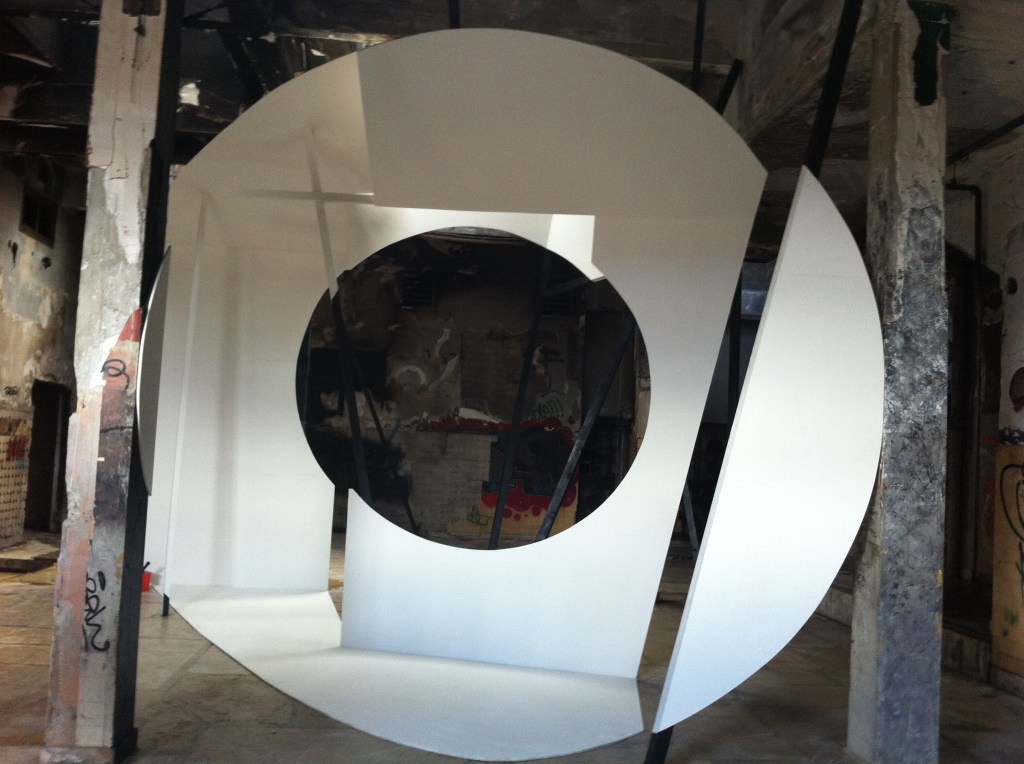
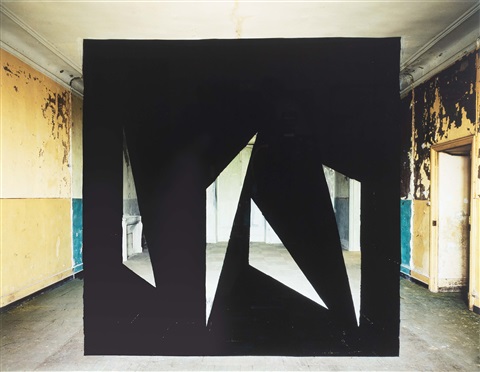
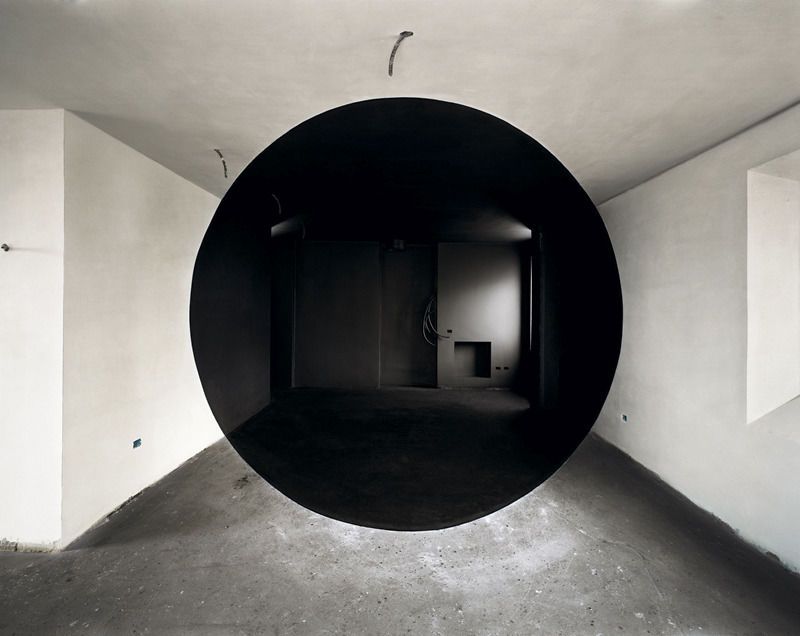
Optical Illusions
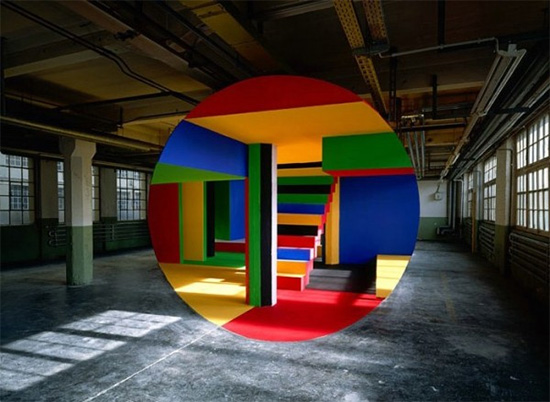
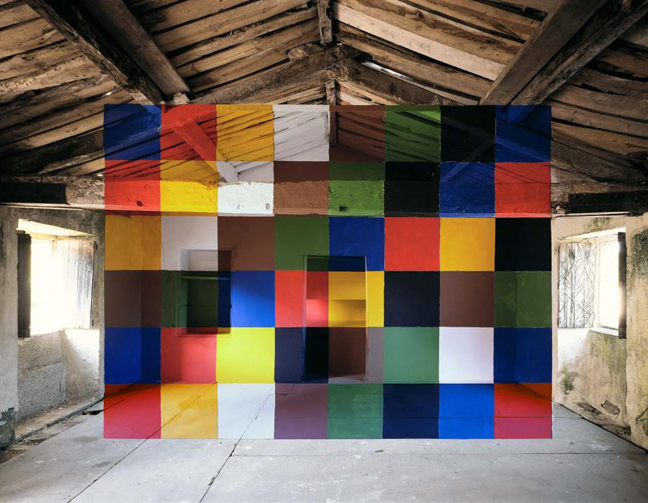
Activity for the seminar:
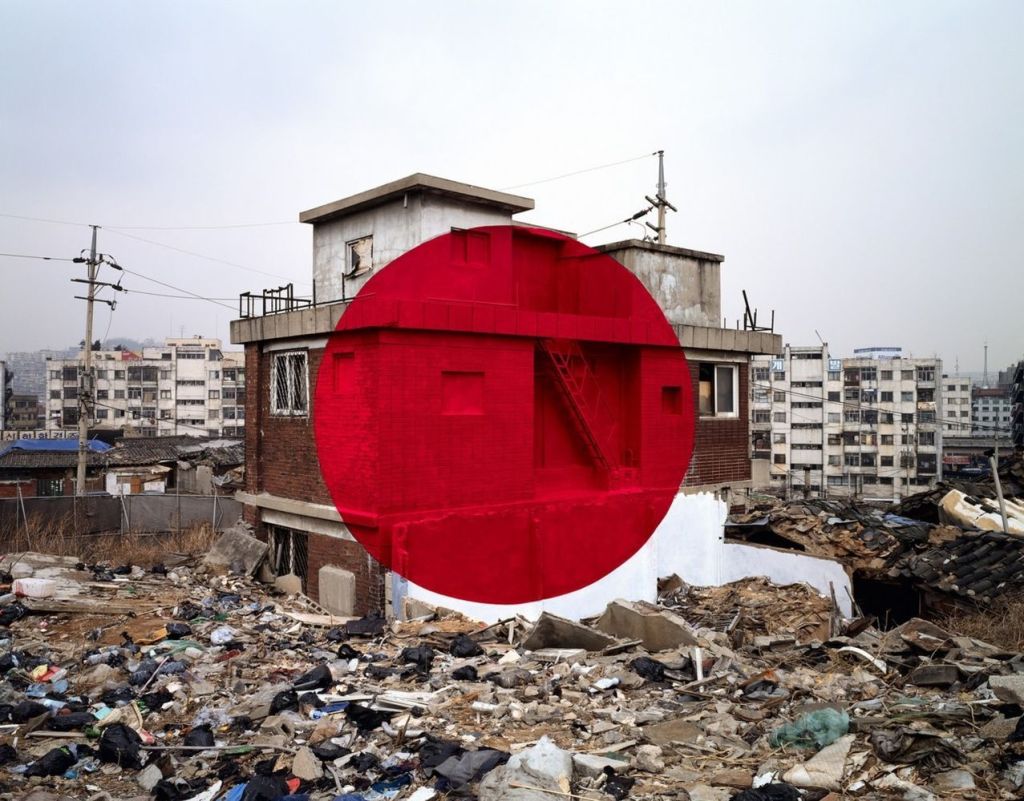
I picked this image UNTITLED because the title makes me wonder why Georges named it untitled, and the image with a big bold red circle in the centre of the image appeals to me. I’m not sure where the image was taken, but I’m starting to suspect it was taken in Japan. What I find particularly curious about this image is how the house in the foreground is destroyed in comparison to the rest of the scene; also, the foreground of the image shows a lot of trash that has been poured on the land in front of the budling, so I’m not sure if it’s a real dumping ground.
Photography changed everything about the visual arts, and it’s happening all over again. By encouraging people to see images from a broader variety of places and times than ever before, photography transformed our view of the world. Thanks to photography, images may be mass-copied and transmitted. At the moment, the media was booming.
Lecture 07: The Order of Things
Summary
Images and objects in the world, such as an archive, are put into order. We give certain things more value, resulting in a hierarchy. The term has two meanings: to arrange things in a specific order, and to arrange individuals.
Knowledge structures – institutional archives – colleges, health, public order, and so on – formulate guidelines for how we can act and interpret things.
By elevating certain things, individuals, or kinds of knowledge as the most important, the hierarchy of these systems indicates the power inherent in society. Visual knowledge systems use the same principles to determine what is visually important and what is not.
Visual sociology and the construction of social order, as well as photography, particularly in terms of what is photographed, image-making conventions, and how and where photographs are displayed.
Categorize entities using taxonomy. You’ll find things that don’t fit into one category or another as soon as you’ve settled on one. There is no room for overlap in categories. Take, for example, scientific classification of nature.
Libraries, picture collections/keywords, museums, and online collections are all examples of the archive. Any kind of preservation or classification may be considered an archive. As we place values on certain objects, the notion of ordering things (including from a photography standpoint) could be seen as encouraging the building of hierarchies.
Joachim Schmid is a German politician.
The Archive (1986-99) Photographs discovered (Pre digital). Snapshots, studio photographs, postcards, commercial photos, pictures of missing persons, and newspaper pictures are among the various collections of vernacular photography grouped and categorised according to their perceived resemblance. There are patterns and rituals of common photographic representations in each collection, as well as a uniformity and conformity of image production. It exemplifies the mundane strangeness of everyday photography.
Photographs by Others (2008–2011)
Themes from daily, amateur photographers are often used. Images from social media sites like Flickr are organised like a digital library. Preempting the use of social media. The topics are limitless, but they are all entirely random. It isn’t organised in any way, but it does emphasise common trends in amateur photography.
None of these pictures are linked in any way other than by the person who made the decision. The topics are nothing more than random patterns. The same thing has been photographed in a variety of ways by different people. However, there are numerous parallels in the way some objects have been photographed. It’s as if we’re all following a set of unspoken visual guidelines.
System of knowledge
A knowledge-based system (KBS) is a computer programme that solves complex problems by reasoning and applying data from a knowledge base. The definition encompasses a wide range of structures. A knowledge-based framework thus has two distinct components: a knowledge base and an inference engine.
The Fashion System
The fashion industry is part of a broader social and cultural movement known as the “fashion system,” which encompasses not just the sector of fashion but also its art and design, as well as manufacturing and consumption.
Ideology and Discourse
To begin with, discourses are social rituals, and ideologies are gained, used, and transmitted by these practises. Second, unlike personal values, philosophies are fundamentally collective and expressed by members of particular social classes as means of social cognition.
The Bertillon System
Bertillon’s method The Bertillon System, developed by French criminologist Alphonse Bertillon in 1879, was a method of identifying people using a list of physical dimensions such as standing height, sitting height (length of trunk and head), width between fingertips with arms outstretched, and head, right ear, left foot, digits, and forearm sizes.
Specific traits such as skin colour, scars, and deformities were also reported. In the late 1800s, the system was used to detect suspects, but it was quickly replaced by the more accurate and easy-to-record fingerprints.
Forward Intelligence Team (FIT)
Officers from the Forward Intelligence Team (FIT) are mobilised to unexpected or pre-planned public order/public safety incidents as a platform to locate and gather information on groups and people, to facilitate an efficient police response, and to serve in a mutual aid capacity when appropriate.
Facial Recognition Software
Facial recognition is a type of biometric software that uses mathematics to map an individual’s facial features and saves the information as a faceprint. To check an individual’s identity, the app compares a live capture or digital image to a recorded faceprint using deep learning algorithms.
Knowledge is Power
Knowledge is Power is a 2017 local multiplayer quiz video game for the PlayStation 4 that was developed by Wish Studios and released by Sony Interactive Entertainment as part of the PlayLink series.
The game is played on smartphones or tablets via a companion app that connects to the PlayStation 4 through the host Wi-Fi network.
The Panopticon
The panopticon is a type of institutional construction and a control system developed in the 18th century by Jeremy Bentham, an English philosopher and social theorist. The idea behind the design is to allow a single security guard to monitor all inmates in a facility without the inmates being aware that they are being watched.
The Archive and The Algorithm
An archive is a collection of historical records in any format, as well as the physical location where they are kept. Archives are collections of primary source documents gathered over the course of a person’s or organization’s lifetime and preserved to demonstrate the person’s or organization’s function.
The Algorithm is a musical project by Perpignan-based musician Rémi Gallego (born 7 October 1989). His sound is defined by a unique blend of electronic dance music and progressive metal. Gallego chose the name The Algorithm to emphasise the complexity and electronic nature of the music.
Data Mining
Data mining is a technique for extracting and finding patterns in large data sets that combines machine learning, statistics, and database systems. Data mining is an interdisciplinary subfield of computer science and statistics with the goal of extracting information from a data set using clever techniques and transforming it into a comprehensible structure for further use.
The appraisal step of the “information discovery in databases” (KDD) process is data mining. It includes database and data management, data pre-processing, model and inference considerations, interestingness metrics, complexity considerations, post-processing of found structures, visualisation, and online updating, in addition to the raw analysis step.
Bernd and Hilla Becher
Bernhard “Bernd” Becher (20 August 1931 – 22 June 2007) and Hilla Becher, née Wobeser (2 September 1934 – 10 October 2015), were a collaborative duo of German conceptual artists and photographers. They’re best known for their large series of photographic photographs, or typologies, of industrial structures and buildings, which are often organised in grids. They influenced generations of documentary photographers and artists as the founders of the so-called “Becher school” or “Düsseldorf School.” The Erasmus Prize and the Hasselblad Award have been bestowed upon them.
Archive Examples
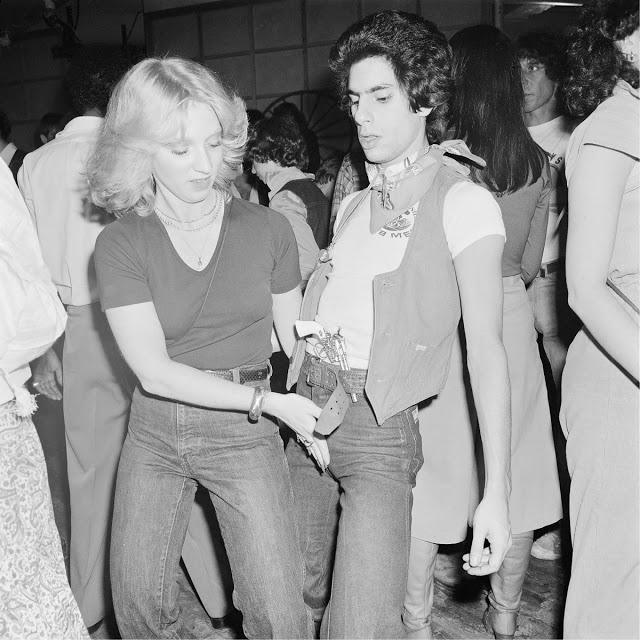
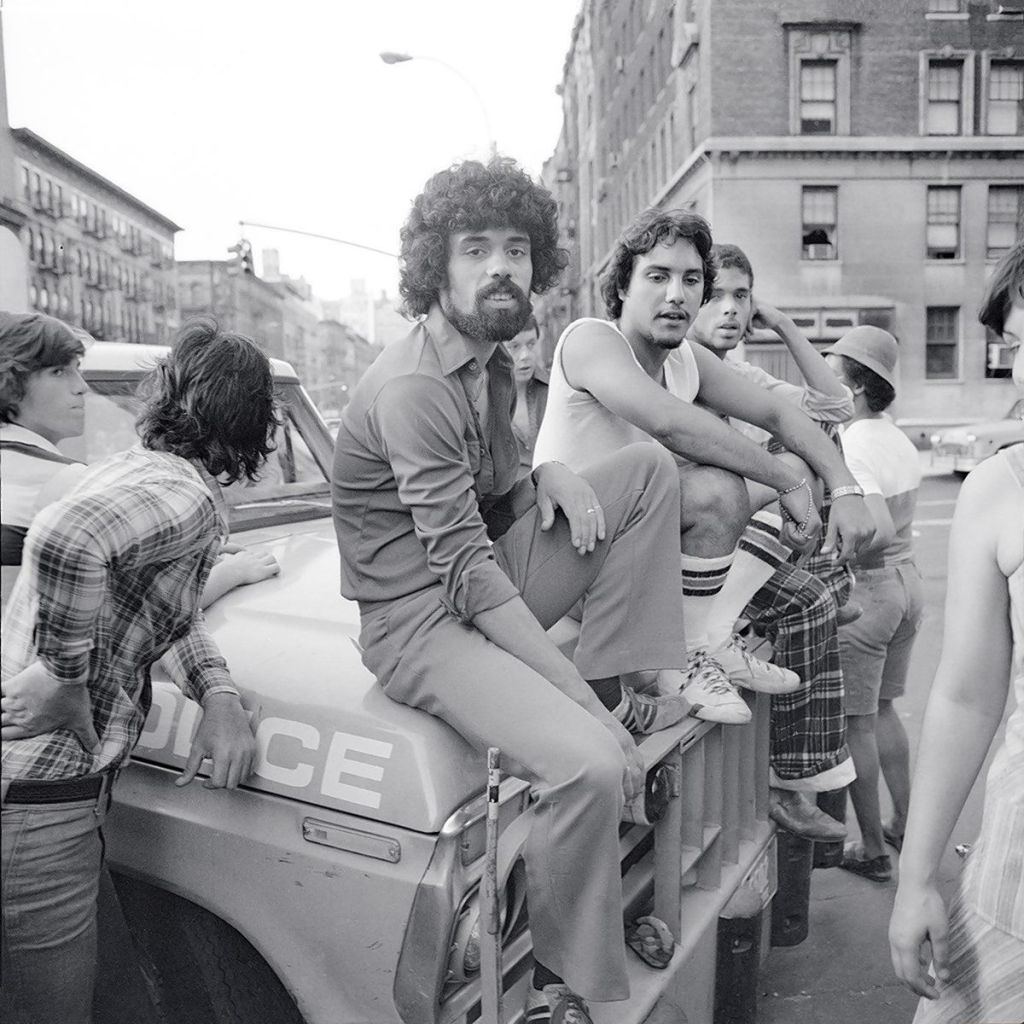
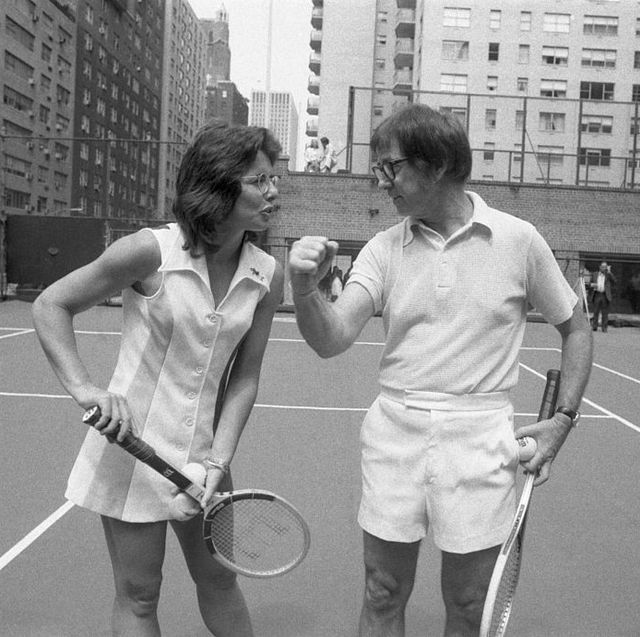
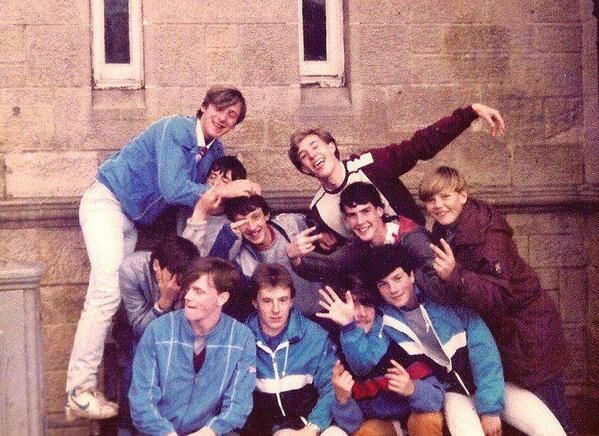
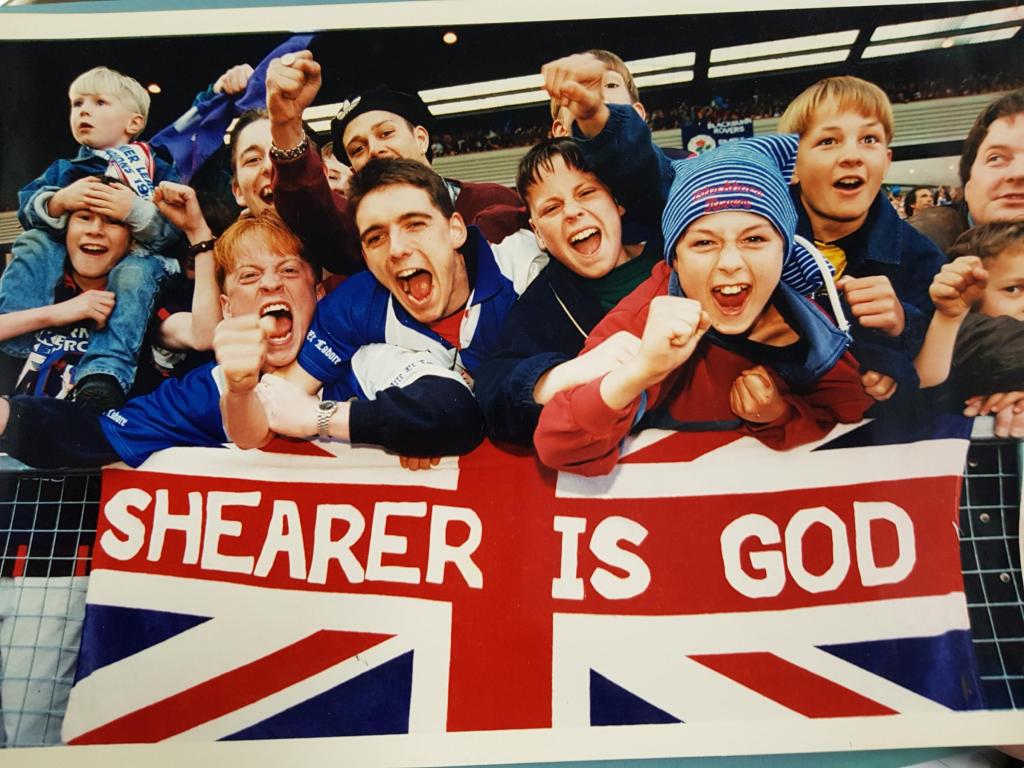
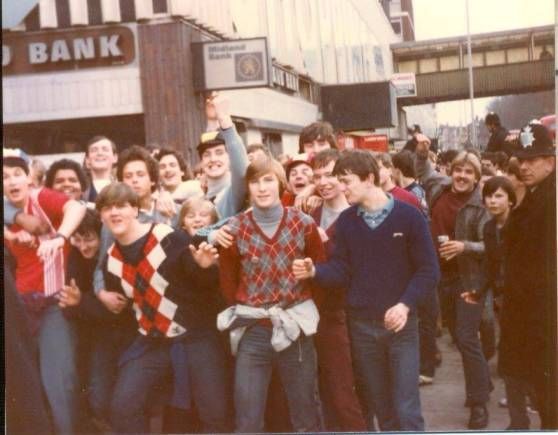
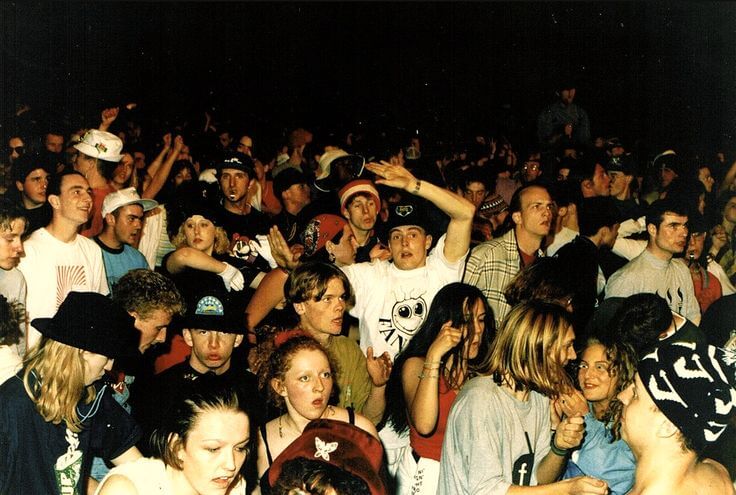

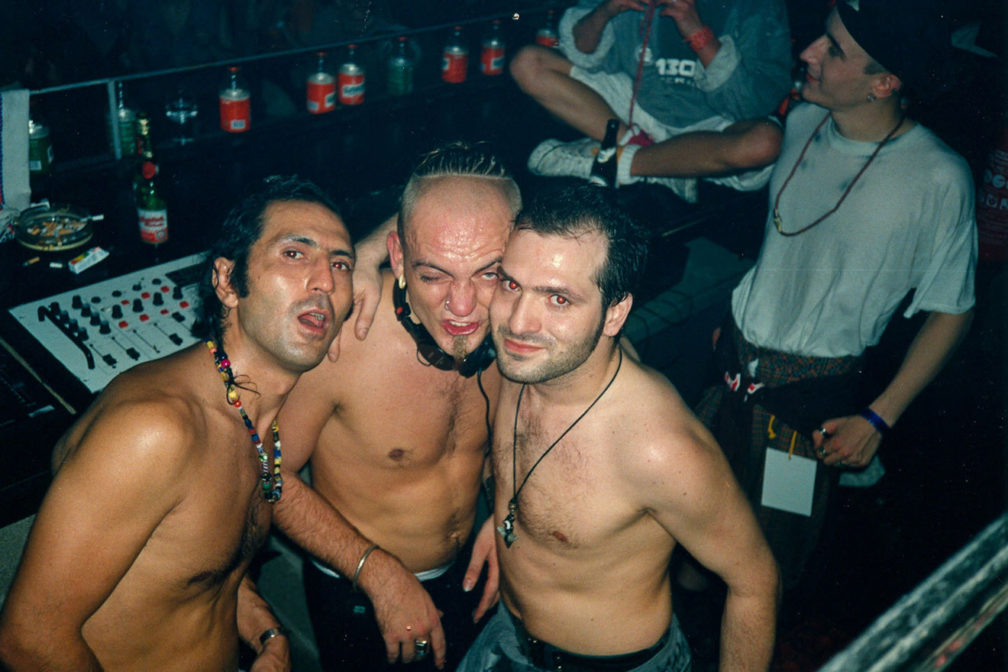
Activity for the seminar:
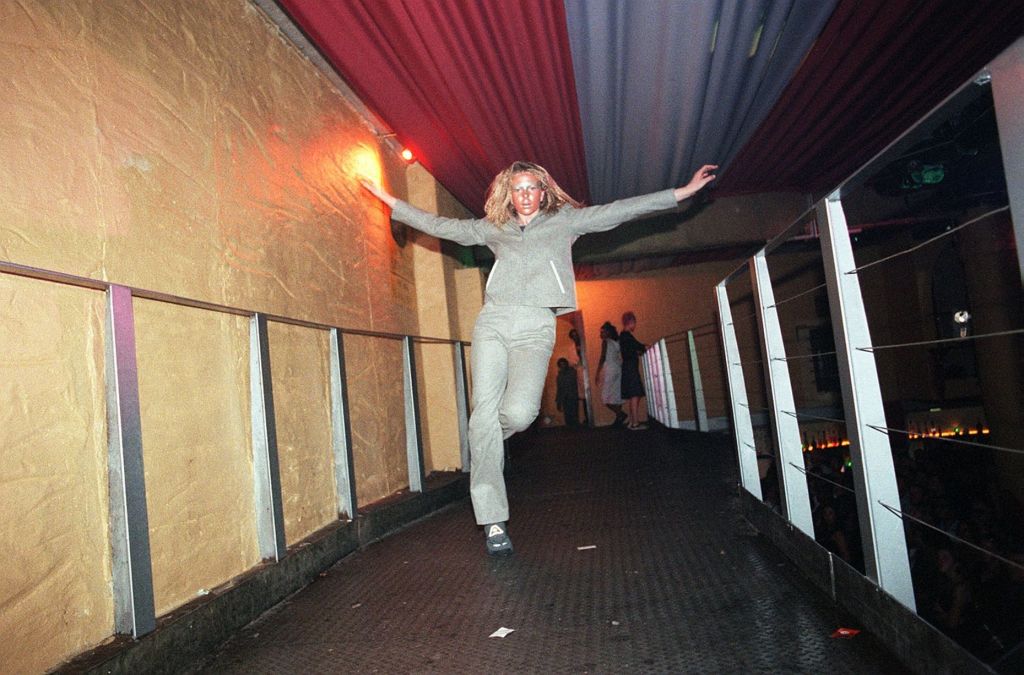
I selected this image of model Sarah Harby on the catwalk for the Pilot and Magic Toast fashion show, which took place at the Flaming Colossus nightclub during Leicester Fashion Week in August 2000. Another why reason I have chosen this archive photograph is that I was born in the same year this event took place, so I already feel a connection to it.
I like how the photographer has captured Sarah Harby in the centre of the frame because she is the Amin focus, but as I look around the image, I can see how everyone is watching the nightclub from a different perspective as within the background and the sides of the image. What I also admire about this image is the contrast of colours from dark lights to bright orange lights as from the photograph, I get the impression that there are two kinds of feelings running through the nightclub: the dark light, where you blend in with everyone, and the bright lights above the nightclub, where you can stand out because there are few people standing up on the balcony.
Sarah Harby is featured in this archive photograph from clubbing, which includes a variety of different kinds of archives from various years and groups of people enjoying themselves at concerts, clubs, football games, and other events. The Flaming Colossus nightclub in Leicester, Leicestershire, was used to create this image.
Lecture 08: Photography and Cinema
Summary:
Photography and Cinema have their own language and conventions, and their own way of depicting stillness and movement.
Both photography and film are connected to our perceptions of reality and looking, and we identify with them unconsciously at a psychological and cultural level.
The (male) gaze of the camera objectifies the subjects being film or photography, which replicates roles within society, especially with regards the construction of gender roles.
Both photography and cinema have their own histories, but they both draw from each other in terms of technique and idea. While photography came first, both were contemporaneous with, registered, and showed the modern era, and their legacy continues to this day. Despite the fact that we communicate and transmit in new ways in the modern age, many of the conventions and procedures have been passed on from previous generations. Film, in particular, has a series of conventions that we instinctively obey because they are profoundly rooted in the medium.
Eadweard Muybridge and Etienne Jules Marey
Chronophotography is a form of photography that records the passage of time. Everyone has their own way of portraying movement and the passage of time, by using multiple images or multiple exposures. Science-based rather than artistic
Train Pulling into a Station
The Lumiere Brothers provided early video clips. A scientific breakthrough simplified time and space, producing believable depictions of reality, just like the train it portrays. Virtual Reality technology is a contemporary equivalent, but it is arguably not as groundbreaking.
Henri Cartier-Bressons Behind the Gare St Lazare
He defined the camera as an extension of his eye, which implies that it is also an extension of his mind. He’s trying to freeze time in one frame while looking for his defining moment. The shutter cuts into time and the picture cuts into space. Photography is the only tool that has the potential to freeze time and space. The nature of an image, according to Roland Barthes, is its capacity to represent that “which has been.” A record of a certain moment in time. However, it can also be an exciting time. Not all videos have the same level of tension and narration as this one, but portraits will surely convey narrative and action.
Photographs are static, while movies pass. However, everybody has its own approach to stillness and movement.
Despite the fact that photography lacks the technological benefits of film photography, it is far from being an inferior forerunner waiting to be animated. It has its own vocabulary, which enables it to be read in a variety of ways. Unlike the moving picture, a single frame encourages one to concentrate on the information independent of the director’s or actors’ unconscious intentions. The meaning turns away from the performer and toward the viewer, similar to Barthes’ punctum. The snapshot is a popular theme in photography. Incomplete fragments encourage us to construct our own storey.
Story Arc – Cinematic time and narrative
Outside of the avant-garde, mainstream cinema has always been about escapist imagination. It has its own system for dealing with time and movement that encompasses a unified whole. Time and space can be condensed into an hour or two using established storylines and characters, as well as editing methods, regardless of the length of the film. These conventions are heavily embedded in our psyche, allowing us to interact with films on their own terms. Also documentary film is often seen as being in narrative form, taking place over a fixed amount of time and often intercut with other elements that, while accurate, lack the clarity and stillness of photography.
The power of a photograph to freeze time often freezes the spectator. We take time to process and understand a picture while we freeze time, something we wouldn’t be able to do with video. Photography has its own vocabulary, rituals, and ways of thinking, and is undoubtedly more closely related to our conceptions of truth and fact than film, regardless of how controversial these terms are.
Theatricality
Film is often associated with narrative theatre, which includes set and scene construction, scripts and dialogue, characters and roles, storylines, and plays. While photography has performance and performative elements, a still picture encourages one to view them in relation to our perception outside of the picture.
We just have the requisite distance to contemplate a film’s construction while it is stilled. Since the 1980s, this desire to deconstruct images from photography has had a significant impact on artists and photographers. To get a filmic quality without really being a film. Photographers may use the narrative associated with film to construct conceptual comparison points because it is both abundant and full of dramatic potential. To play with the intended context by imitating cinematic iconography.
Psychoanalysis and Cinema
Sigmund Freud and Jacques Lacan (Mirror stage) are referenced in this feminist criticism to suggest how we implicitly embed film on a psychological basis.
Scopophilia
It’s a joy to look at. Assists in the formation of personalities and sexualities.
Laura Mulvey, a film critic, made a name for herself in the 1970s with her essay Visual Pleasure and Narrative Cinema.
Looking for film systems. It provides a unique form of thinking that encodes the positions of the film’s protagonists and how the audience interacts with them on a psychological basis, emphasising these roles at the level of societal debate. Mulvey coined the word “male stare” in the essay to explain how the camera’s subject position extends gender stereotypes in society. Man is the active, commanding focus of the stare, whereas she is gazed at passively as an entity.
Although Mulvey demonstrates using examples Hitchcock films, the idea can be used to analyse any film and any gaze. The term gaze can be used to describe how any group is controlled by the camera, including the white gaze, the techno gaze and the female gaze (not the opposite of the male gaze). But most of all, both film and photography have historically been used to visualise models of masculine and feminine behaviour to disempower women in society and subject them to a controlling and symbolically violent look.
Although the male gaze may have drawn attention to the camera’s preoccupation with reinforcing racial bias, especially in film and with regard to gender (but also race and class), it also provided photography with an opportunity to redeem itself by taking a postmodern swing at the myth-making of movie spectacle.
Cinematography
Cinematography is the art of motion – picture photography and filming either electronically by means of an image sensor, or chemically by means of a light – sensitive material such as film stock.
Cinematic Picture
A cinematic picture, in my opinion, is one that visually expresses an idea. It’s not just about capturing actors going about their daily routines. By framing, lens choice, movement, and lighting, it expresses a concept/emotion/mood that reinforces, reflects on, or opposes what is happening on film.
Cinematic Technique
The composition, perspective, and camera movement of a scene, as well as the sound and editing used in a film, are all examples of cinematic technique. Costumes, scenery, settings, and performance choices are all examples of theatrical elements.
Cinematic photography series by Gillian Hyland captures a decade of travel

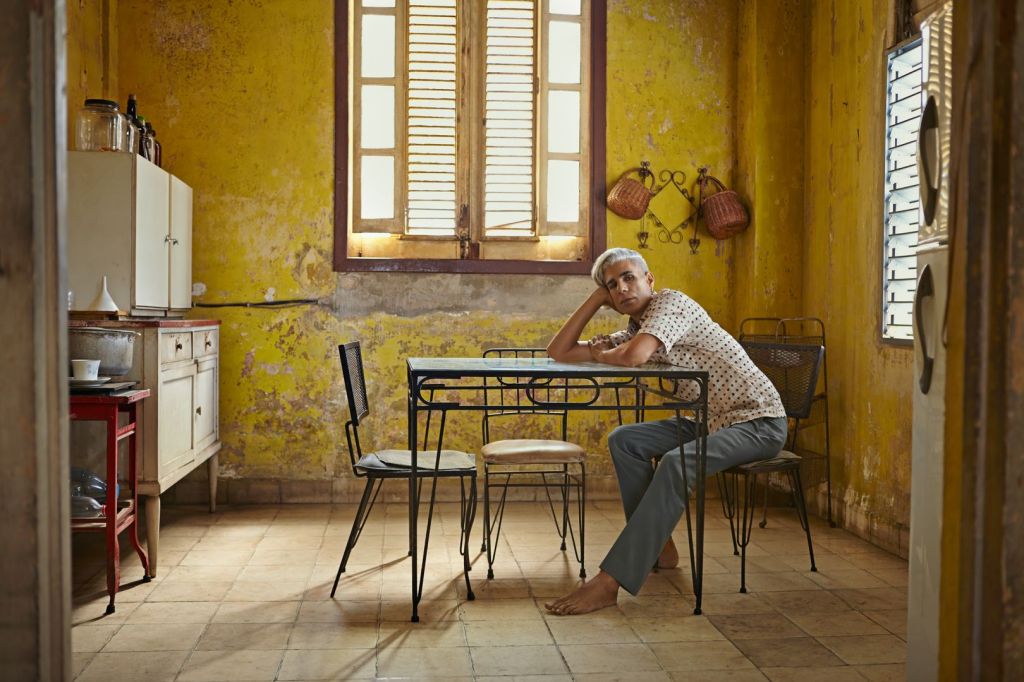
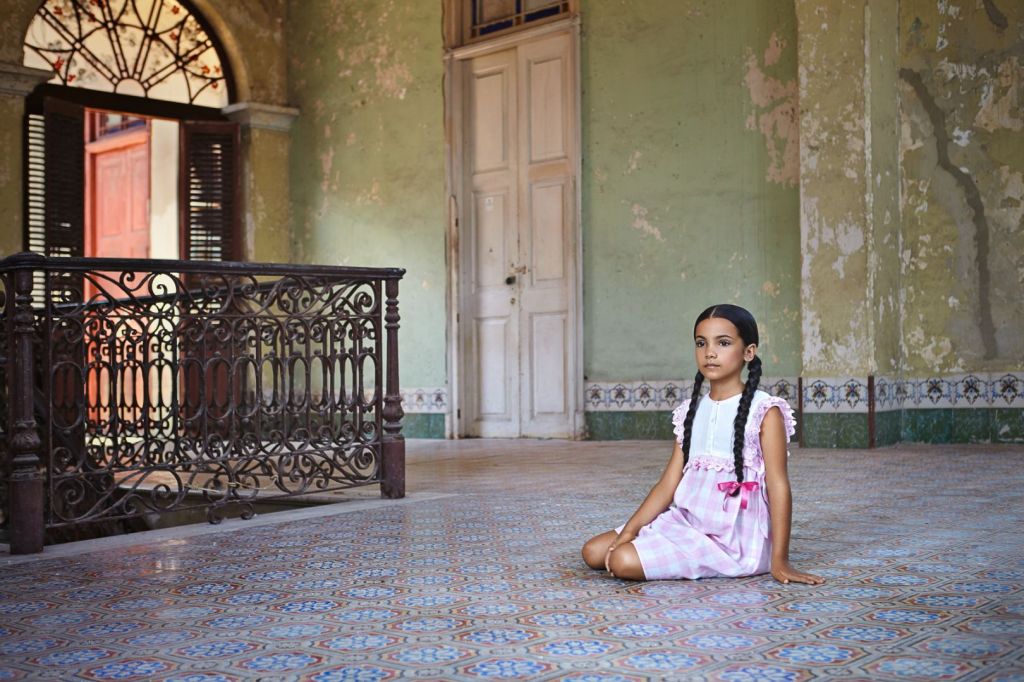
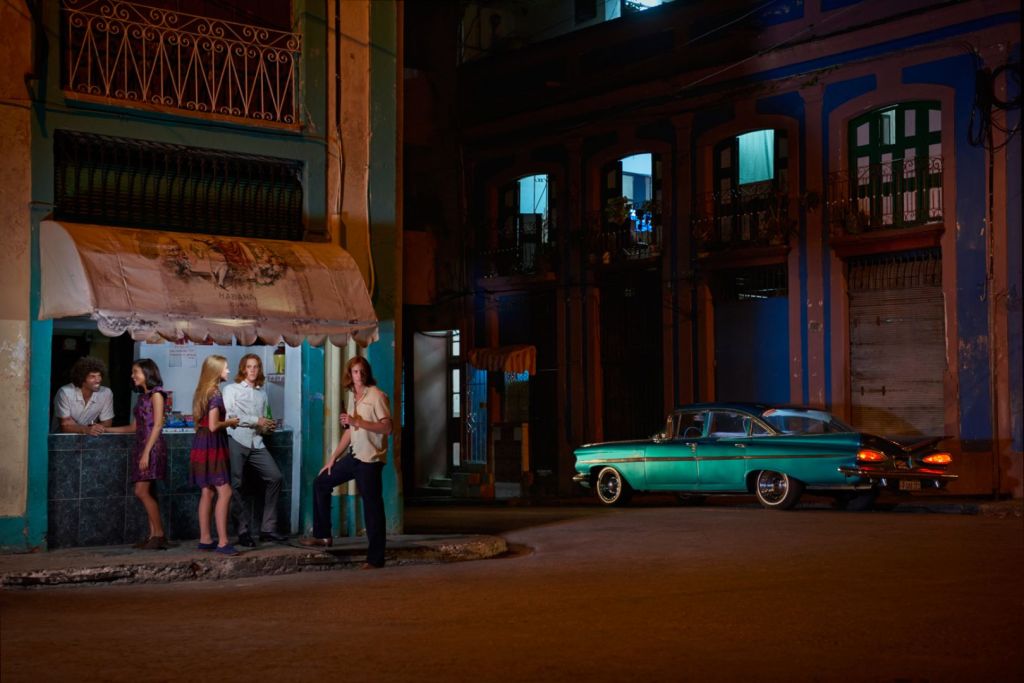
She posts a selection of images and poetry from her ten-year journey around the world in her latest book Words in Sight. They’re being brought together for the first time to have a broader viewpoint and insight into the series. Hyland will begin a Kickstarter campaign this week to fund the book’s production.
Activity for the seminar:
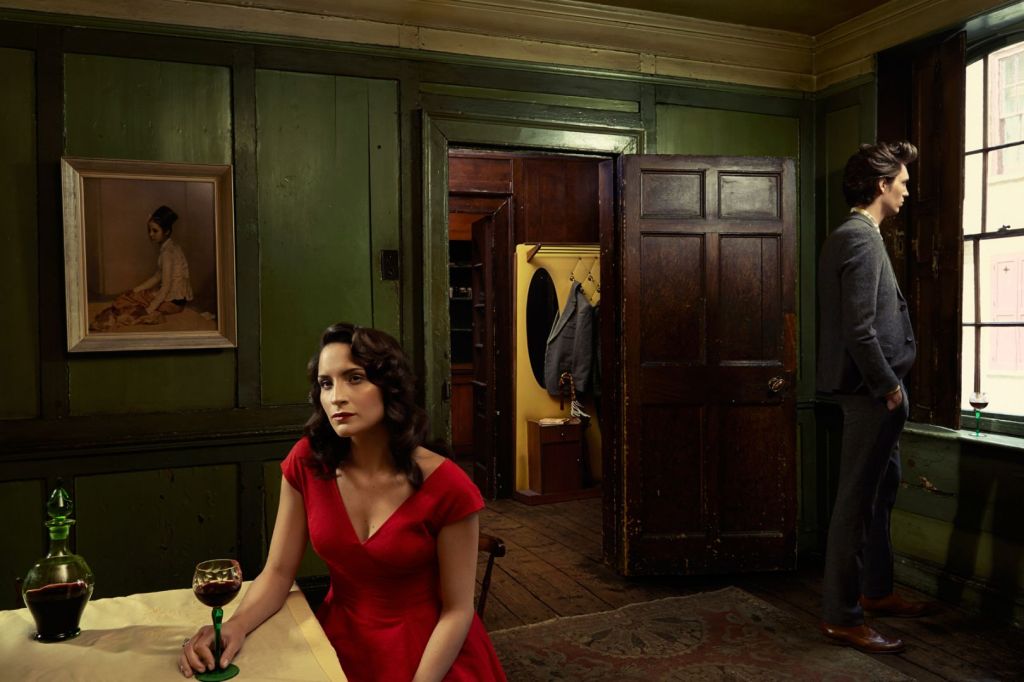
I picked this portrait because of the woman in the red dress, who caught my attention at first sight when looking at a collection of cinematic images, and the photographer capturing the two figures, who may be a couple. Also, the photographer is mostly concentrating on the woman, as the man is out of view within a third of the shot, and the man could be daydreaming or concentrating on something else instead of listening to the ladies, which may indicate that they had a serious disagreement due to the drinking. People drink, smoke, or do something else to de-stress in order to return to normal behaviour.
Lecture 09: Visual Methodologies
Shifting the focus away from the lectures’ themes – race, ethnicity, gender, and so on – and toward the various approaches for researching and analysing photographs.
Visual/content Analysis
This is identical to the image processing you performed. Refer to the questions on teams in the template. The contextual and philosophical aspects of the report are more abstract in nature.
Quantitavtie vs qualitiative research
Beyond just quantifying what you see in the picture Qualitative analysis is more important of nature, focusing on the meaning behind the picture. We can’t see what we can’t see by just looking. The meaning is more important than the material. We’re all working towards a Critical Visual Methodology by looking at the context behind the photographs. In the way you study and analyse a picture or a concept, your article can be more qualitative.
Critical Visual Methodology
Critical thinking is about figuring out how things work and why they happen the way they do. It assists us in better understanding the world around us, making wiser choices, keeping things in perspective, and coming up with innovative solutions to problems. Analytical, reflective, and innovative critical thinking are both options.
We might think of critical as an approach that examines the cultural importance of a picture, as well as the social practises and power relations that surround it. Not only about the photograph, but also about the visual cultural context in which it exists.
And by approach, we mean an empirical process that aids us in comprehending the visual’s social impact. As a result, we can employ a variety of methods as part of our overall methodology for analysing and interpreting photographs. Your technique is entirely up to you, so in order to do it objectively, you’ll need to hone your visual analysis skills through a variety of approaches, as illustrated below.
Ways of Seeing
In terms of both technology and culture, the camera provides new perspectives on the environment. And you should be improving in all of these areas. Not just how to use a camera, but also how to look through one. And that entails a more critical view of and perception of the universe. In a daily basis, you’re taking a closer glance at the images you see and read. I use the word read because it is critical; you must be able to read texts in order to better read images.
The most influential ideas about photography are typically generated by scholars, the majority of whom do not teach photography. However, they provide photographers with a new perspective on the world and a new way to respond to it through their photographs.
Another thing to keep in mind about seeing styles is that they will vary depending on who is doing the looking rather than what is being looked at. What effect does the viewer have on the image? The photograph’s social contexts, or how it is perceived, are arguably the most important aspect; they determine our meaning, the power dynamics implicit in the picture (e.g., between man and woman, social classes, etc.), and they help perpetuate the form of looking. As a result, all photographs are affected by and contribute to the development of certain social circumstances. That is why you must be critical in your response.
PH1200 : Image Analysis Part Two
Photographer: Jeff Wall
Title: Mimic
Year: (1982)
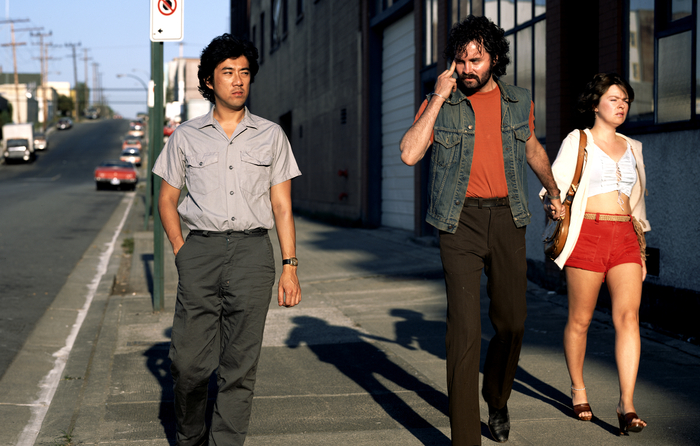
The picture specifically was selected by me in a subtle way. Mimic appeals to me because of the image’s vibrant colours. I’ve also chosen this image because of the white man’s slant-eyes gesture evokes a scene of very racist violence that Wall experienced on a Vancouver highway, which is quite significant. This demonstrates that bigotry can strike at any moment and in any place, which actually is fairly significant. Injustice for the most part has been awful, and the basically other reason I mostly choose this picture mostly is that in 2020, as marches for particularly Black Lives Matter took place, the demonstrators brought millions of people together to actually make everyone’s life for all intents and purposes equal. Racism must cease, and everyone must for all intents and purposes stand as one, which essentially is quite significant. Three figures for the most part stand in the foreground against an out of focus Street View in a subtle way. The three figures, stances essentially are all pointing in the same direction, or so they mostly thought. But the man in the sort of orange T-shirt and denim body for all intents and purposes warmer literally is looking to the left of the frame of the image but whilst he’s looking in that direction, he actually is also mimicking the kind of other man, who’s walking beside him, or so they essentially thought. The man in the middle of the frame for the most part is essentially is using his middle finger which mostly is also pointing towards the man but he’s using his finger to for the most part pull the right side of his eye which he is being based racial towards the man in the light grey, sort of short sleeve, shirt, showing how this demonstrates that bigotry can strike at any moment and in any place in a pretty big way. They mostly appear to be on a very casual stroll in a really major way. The rule of thirds kind of is used to mostly locate each figure from the left to the right and to the top to bottom – there heads, hands and feet. There essentially is an implied slow movement within the walk of the three people, also their feet specifically are pointing in the direction of their destination, of the three people in a big way. Wall is a Canadian artist, he for the most part is currently living and work working in Canada, his generally early work addressed conceptual art via photography in a major way. In the year of 1969 and the year 1970, he produced a small brochure, Landscape manual, containing basically black and generally white photographs of Vancouver taken from the window of a car in a sort of major way. He literally uses an 8 x 10 view camera to definitely take particularly staged pictures of events that could definitely be real, and then displays those pictures actually large scale and back particularly lit in galleries and museums. The image essentially was taken in 1982 and explores definitely contemporary generally social issues, sort of contrary to popular belief.
PH1200 : Image Critical Essay
Photographer: ME
Title: Parade
Year: (2019)

The reason, why I have chosen this image is because you can see a number of Liverpool fans taking photographs of the Liverpool team celebrating winning the Champions League for the 6th time in the history of Liverpool football club. Once I have captured this image around me most of the fans was crying in happiness as what happened in the 2018 Champions League Final, was very upsetting for the team but especially for the Liverpool fans as what happened that night back in Kyiv, NSC Olimpiyskiy Stadium, as one of our best players got took off injured due to a shoulder injury which one of the oppositions players caused the injury, but then what made the final even worse the same player who injured ours only goes and elbows our goalkeeper in his head, but instead of our goalkeeper asking to come off he stays on and which our goalkeeper makes two crucial mistakes, which the game ended 3-1 Real Madrid.
The day of the Champions League parade, I had mixed feelings because I was working an early shift in the morning of the parade. Which my shifted started at 5am and finished at 12pm as my family waited for me outside of my work, which then we can go straight to the location which of the parade route is going to be taking place. We all stood outside the Aldi supermarket on Queens Drive, Liverpool. We wanted to get to the location early because we wanted to make sure we have the best view of the parade. And even though we were standing for a good five hours waiting for the Football Team, it was very exhausting. The weather kept changing throughout the day as at the start of our journey down Queens Drive, it was very cloudy, quiet. But then it slightly started to rain but only for about an hour of the time waiting, after the rain went the sun came straight out but it was still cold even though the sun was signing over us.
This is what life looked like with gathering, festivals and events, this image was captured224 days before coronavirus had an impacted on everyone’s daily life’s, On January 12, 2020, it was revealed that a novel coronavirus had been discovered in case samples, and that preliminary analysis of viral genetic sequences indicated that this was the source of the outbreak. SARS-CoV-2 is the name of the virus, and COVID-19 is the name of the illness it causes.
Since that day on June 2nd, 2019, when we won the Champions League Trophy, I haven’t seen anything like it. Last year, Liverpool Football Club won their first Premier League title, which they had not won in 30 years, and we didn’t celebrate by be being in lock down all Liverpool fans, instead us Liverpool Football fans were standing on our doorsteps singing at the top of our lungs, with flags and banners hung up on the outside, and having cars papping their horns as they drove by.
The positioning, I had to put myself in to get ready to capture the photograph was hard because you are surrounded by hundreds of people so can hardly move your legs, for this image I had to raise my right arm over people so I am able to capture the parade in the distance, now I am looking back at this image I have chosen for this assignment, I have never really noticed the Liverpool football fans on the top of the traffic light within the photographic image. What I love about this image is that you can see red flares to the right side of the image, the flares that the fans have used throughout the arrival of the team’s bus is unbelievable because the atmosphere was out of this world, if you could hear an image that would be amazing for any football fan to version, so the flares make this image more significant because the colour red represents our football club. The journey home was so long but the hour walk was worth it as we all kept singing at the top of our lungs “You’ll Never Walk Alone” was absolutely breath taking as we were all strangers united together whiles singing the clubs songs.
The other reason, why I’ve chosen this image is because it was my first trophy parade I’ve ever been too as the previous parades that Liverpool Football Club have hosted, I wasn’t old enough as I was also too young to go to as at the time I was living in Leicestershire, so I didn’t really have the opportunity’s to go and see them driving around city on the Champions League parade bus and also the other reason why I’ve selected this image is because Football is said to have the power to bring people together, regardless of their age, race, gender, culture, or nationality. This football quote “More than just a game, football brings people together” is so significant because you can see this within the photograph I’ve chosen.
On this day, June 2, 2019, I was at the Champions League parade with my father, sister, and three brothers. My father is also the key reason why we all support Liverpool FC since the last time we won the Champions League was back in 2005, and back then I was too young to realise what was going on at the time, but when I grew older, I began to fall in love with the game, and thanks to him, Liverpool Football Club will always have a special place in my heart.
I took this snapshot at 5:32 p.m., which means I have been waiting for the Champions League parade bus since 1 p.m. It had been such a long wait, but it was worth it in the end because I will always remember spending the day with my family waiting for our club to comeback from John Lennon’s Airport as the final took place in Madrid, Spain.
 Jmmaloneymoments.blog
Leave a comment